
NEW DELHI– India is aiming to expand its space economy to $44 billion by 2033, supported by growing private investment, commercial partnerships and advances in launch vehicle and satellite technologies, according to a government factsheet released Wednesday.
The government said India’s space program is evolving beyond scientific exploration and national security to become an increasingly important contributor to economic growth, industrial development and private-sector innovation.
Emerging technologies, including reusable launch vehicles, air-breathing propulsion, electric propulsion and spacecraft docking systems, are expected to play a major role in expanding the country’s commercial space capabilities.
NewSpace India Limited (NSIL), the commercial arm of the Indian Space Research Organisation (ISRO), has signed 118 technology transfer agreements covering 83 technologies developed by ISRO for use by Indian industries.
Private investment in the sector is also increasing. Cumulative funding for Indian space startups reached approximately $618.5 million as of March 31, 2026, with investment activity increasingly moving beyond early-stage financing toward larger funding rounds for expanding businesses.
The government said these developments are helping create an industry-driven space economy capable of supporting both domestic requirements and international commercial opportunities.
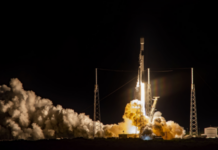
A major component of India’s long-term space strategy is the development of the Next Generation Launch Vehicle (NGLV), which is intended to significantly increase the country’s ability to carry heavier payloads into orbit.
The Union Cabinet approved the NGLV development program in September 2024 with an allocation of Rs 8,240 crore. The funding covers vehicle development, three test flights, supporting infrastructure, program management and launch operations.
The new launch vehicle is being designed to carry up to 30 metric tons to low Earth orbit, three times the 10-ton capacity of India’s existing LVM3 rocket.
A partially reusable version of the NGLV is also under development, with a planned payload capacity of 14 metric tons to low Earth orbit. Reusable technology is expected to help reduce launch costs and improve the commercial competitiveness of India’s space industry.
The NGLV is expected to support a wide range of missions, including crewed spaceflights, lunar exploration, interplanetary missions and the deployment of large satellite constellations.
India is also advancing plans for the Bharatiya Antariksh Station, its proposed space station, while continuing work on Gaganyaan, the country’s human spaceflight program.
Another major technological milestone came through the Space Docking Experiment, known as SpaDeX, which made India the fourth country to successfully demonstrate autonomous docking between two spacecraft in orbit.
Beyond exploration and commercial launches, the government emphasized the growing importance of space technology in everyday economic and public services.
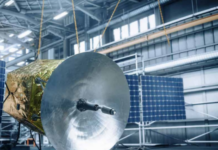
Communication satellites help extend connectivity to remote and underserved regions, while Earth observation systems provide information used in agriculture, urban planning, environmental monitoring and disaster management.
Weather satellites also play an important role in monitoring cyclones, monsoon patterns and other severe weather conditions, providing early warnings to farmers, fishermen and coastal communities.
Satellite-based systems additionally support national security, border monitoring and strategic communications.
The government said the combination of expanding private participation, new launch technologies and commercial applications is expected to strengthen India’s position in the global space industry.
With investment flowing into startups and advanced technologies moving toward commercial use, India is seeking to establish a larger presence in the international space market while expanding the domestic economic benefits of its space program. (Source: IANS)