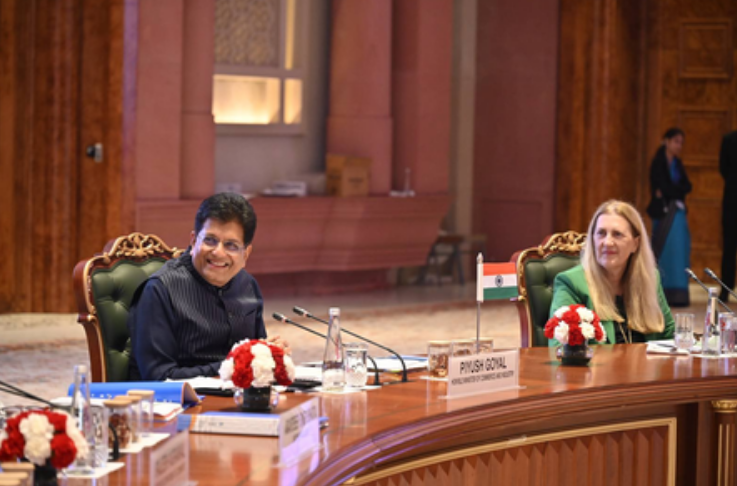

NEW DELHI– The India–EFTA Trade and Economic Partnership Agreement (TEPA), which took effect with a $100 billion investment target and the creation of one million direct jobs, is being hailed as a landmark in India’s economic engagement with Europe. The pact represents what Commerce Minister Piyush Goyal called “a trusted partnership between friends,” grounded in mutual respect and sensitivities.
The agreement expands access for goods and services across Switzerland, Norway, Iceland, and Liechtenstein. Notably, TEPA is the first trade agreement to include a binding investment commitment, a provision Goyal described as a step toward balancing interests and ensuring fairness among partners.
Highlighting the small population of the four EFTA nations — collectively fewer than the residents of Mumbai — Goyal said the pact is nonetheless powered by the “big heart and tremendous potential” of the region. He also noted the auspicious timing of TEPA’s launch, coinciding with Navami and Vijaya Dashami, symbolizing prosperity and the triumph of good over evil.
Calling TEPA a “beacon of stability and certainty” in an era of global trade volatility, Goyal underscored the diverse opportunities it opens up, spanning sectors such as life sciences, clean energy, precision engineering, food processing, artificial intelligence, education, culture, tourism, shipbuilding, and advanced manufacturing. India, he said, looks forward to deeper cooperation with Iceland on geothermal energy, with Norway on maritime services, and with Switzerland and Liechtenstein on innovation, R&D, and high-value manufacturing.
India’s competitive advantages, including some of the world’s lowest data costs — at just 3 percent of U.S. levels and under 10 percent of the global average — were emphasized as a key driver of global capability centers. Nearly 2,500 such centers now support Fortune 500 companies from India.
Goyal cited the longstanding presence of Swiss giants like Nestlé and ABB in India as evidence of the country’s role not only as a strong market but also as a base for global expansion. He added that the high valuations of companies like Nestlé India and ABB India reflect strong confidence in India’s growth trajectory.
Inviting businesses from EFTA nations, Goyal assured them of India’s open, transparent, and investor-friendly environment, with 100 percent FDI permitted in nearly all key sectors. He stressed that TEPA is not just about tariff cuts or investment pledges, but about creating a predictable and trusted framework that boosts investor confidence, lowers uncertainty, and signals a shared commitment to sustainable growth.
Commerce Secretary Rajesh Agrawal echoed this view, calling TEPA’s operationalization “a strong signal of collective wisdom and will to strengthen free and fair trade.” He said the pact marks not just a trade arrangement but “the beginning of a new era of shared growth, innovation, and prosperity.”
Agrawal also pointed to India’s rapid economic rise, noting its position as the world’s fourth-largest economy on track to becoming the third, and said the investment commitments under TEPA reflect the global confidence in India’s long-term story. (Source: IANS)