
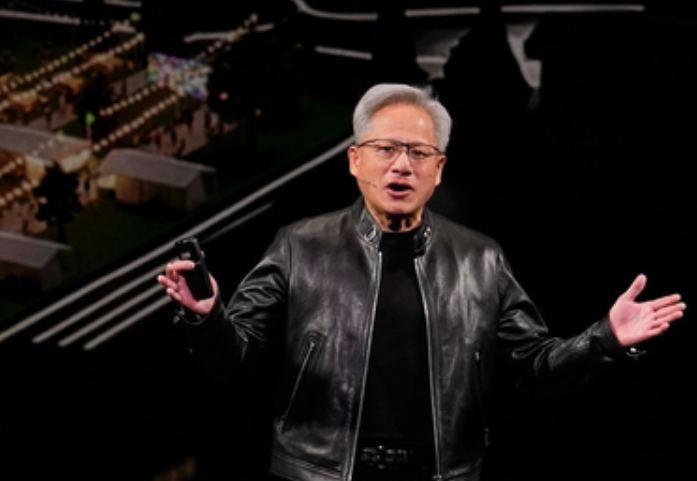

Chapel Hill, North Carolina — Nvidia CEO Jensen Huang pushed back against fears that artificial intelligence will lead to widespread job losses, arguing that AI will automate individual tasks while allowing workers and companies to accomplish more.
“The idea that somehow all the jobs are going to be eliminated, removed, that’s just nonsense,” Huang said during a fireside chat with U.S. Commerce Secretary Howard Lutnick.
Huang said that while AI will increasingly automate many of the skills and tasks involved in existing occupations, the broader purpose of those jobs will remain.
“Those skills are gonna be automated by AI. The tasks are gonna be automated, but our jobs purpose remain,” he said. “And so I think what’s gonna happen was that we’re all just gonna be supercharged.”
Nvidia is already using AI extensively across its own operations, Huang said, combining commercially available tools with technology developed internally.
“You should use AI off-the-shelf wherever you can, but don’t forget, you have to invest in building your own intelligence, every country, every company,” Huang said. “You can’t outsource all of your intelligence to somebody else.”
Huang also predicted that artificial general intelligence, commonly known as AGI, could emerge within the next few years. He said some elements associated with AGI may already be present, but cautioned that more capable AI systems will not automatically make companies productive.
“It’s not as if all of a sudden in two years time, I say, okay, let me connect it to this AI service and I just sit back and all of a sudden my company becomes more and more productive overnight,” Huang said. “That’s just not gonna happen at all.”
Businesses will still need to provide AI systems with appropriate context, information, objectives and access to the tools necessary to perform useful work, he said.
Huang described the AI economy as a “five-layer cake” consisting of energy, chips, infrastructure, models, and data and applications. Countries do not need to dominate every layer, he said, but should determine where they can invest effectively while encouraging AI adoption in industries such as healthcare, manufacturing, education and science.
“Every single country needs to build infrastructure so that you could support your own local economy,” Huang said. “It becomes the capacity, the intellectual capacity, the digital intellectual capacity for you to support your researchers and students and society and industries and startups.”
The Nvidia chief said the United States is expected to invest nearly $1 trillion in AI infrastructure this year, with spending creating economic activity and jobs in semiconductor manufacturing, computer production and data center construction.
Huang urged governments to consider AI’s economic potential alongside concerns about safety, arguing that one of the greatest risks for countries is failing to embrace the technology.
“The worst outcome is that you don’t take advantage of it. That you are left behind. That is the single worst outcome,” he said.
He also called on governments to focus regulation on demonstrated problems rather than theoretical risks.
“Don’t regulate hypothetical, theoretical harm. Regulate actual and pragmatic harm,” Huang said.
Lutnick similarly argued that countries will need to build domestic data centers and AI infrastructure if they want their citizens and businesses to benefit from the technology.
“They’ve got to harness the AI for themselves,” Lutnick said. “Because what you’ve said is that education has been democratized.”
Nvidia was founded in 1993 by Huang, Chris Malachowsky and Curtis Priem. The company’s graphics processing units, originally developed primarily for computer gaming, have become essential components of the massive data centers used to train and operate advanced AI systems. (Source: IANS)