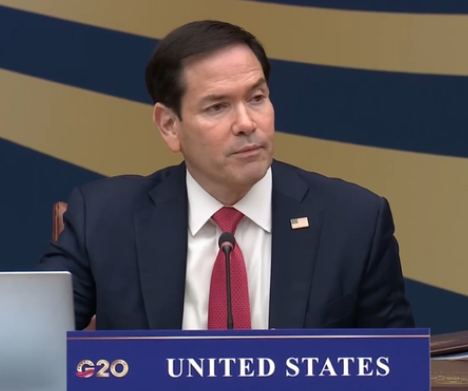
ATLANTA–U.S. Secretary of State Marco Rubio warned foreign ministers from the Group of 20 nations that escalating geopolitical tensions and economic disruptions pose serious risks to global energy supplies, food security, international trade and freedom of navigation.
Speaking at the opening of the two-day G20 Foreign Ministers’ Meeting in Atlanta, Rubio called for greater international cooperation to address challenges that are increasingly interconnected and threaten economic stability worldwide.
“We are facing a series of interconnected economic and geopolitical crisis, many of which pose severe threats,” Rubio told the gathering.
India’s External Affairs Minister S. Jaishankar is leading the Indian delegation at the meeting, which brings together representatives from the world’s major developed and emerging economies.
Rubio identified disruptions to energy markets, agricultural supplies, international shipping routes and global supply chains as major concerns requiring coordinated action.
He said the G20 must strengthen economic resilience, safeguard international markets and address geopolitical risks that could undermine global prosperity.
The secretary of state emphasized that the challenges facing the international community during President Donald Trump’s G20 presidency extend beyond individual countries and require diplomatic cooperation.
According to Rubio, the foreign ministers’ meeting offers an opportunity to promote geopolitical stability while laying the groundwork for economic priorities that G20 leaders will consider at subsequent discussions.
“We are tasked, on behalf of the nations that we serve, to work together with one another to coordinate responses to emerging crisis and to protect our shared interests,” Rubio said.
“By translating our shared interests into practical cooperation and real action, we can reinforce global stability,” he added.
Rubio said stronger coordination among member countries could produce tangible economic benefits for their citizens while reducing vulnerabilities in international markets.
The opening plenary focused on two major issues affecting global economic security: freedom of navigation and food security.
“We’re going to cover two issues in this plenary session, freedom of navigation and food security,” Rubio told participating ministers.
Freedom of navigation has become a critical economic concern because international maritime routes carry much of the world’s energy shipments, agricultural commodities, manufactured products and other essential goods.
Disruptions along major shipping corridors can increase transportation costs, delay deliveries and create shortages that affect businesses and consumers across multiple countries.
Food security presents another challenge, particularly for nations that rely heavily on imported agricultural products, fertilizers and energy. Supply interruptions can raise food prices, reduce agricultural productivity and intensify economic pressures on vulnerable populations.
Rubio said ministers would examine both subjects during separate discussions, allowing each delegation to present its views and priorities.
For India, the discussions carry particular significance because of the country’s dependence on imported energy and its growing participation in international commerce.
Reliable maritime transportation, stable energy markets and resilient global supply chains remain essential to India’s economic growth and trade relationships.
The issues also align with priorities India emphasized during its G20 presidency in 2023, when New Delhi promoted international cooperation on economic resilience, food security and sustainable development.
The G20 includes major economies such as the United States, India, China and Russia, along with the European Union and other members. The forum serves as a platform for addressing global economic challenges, coordinating policy responses and promoting international financial stability.
Rubio’s remarks highlighted the growing intersection of diplomacy and economic security as G20 members seek common ground on challenges affecting trade, energy access and global markets. (Source: IANS)