
Seoul– South Korea’s LG Group is exploring opportunities in the space industry and assessing the feasibility of entering the sector, according to the Korea Aerospace Administration (KASA), which held a meeting with company officials on Friday.
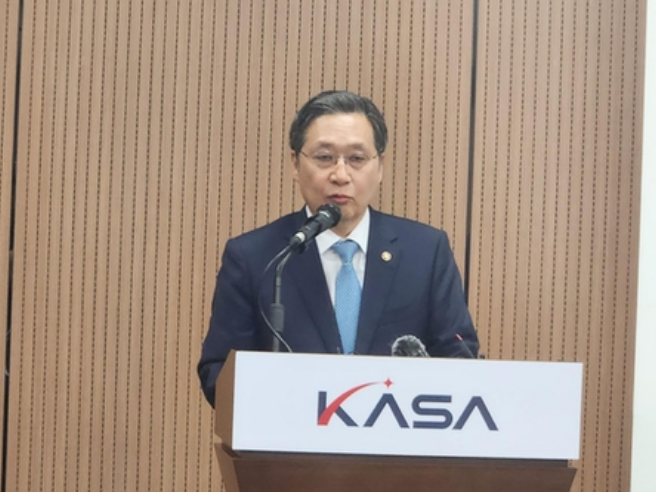
KASA Administrator Yoon Young-bin met with LG representatives at the company’s research and development complex in Seoul to discuss strategies for strengthening the private sector’s role in advancing South Korea’s space capabilities. During the discussions, LG provided updates on its review of space-related technologies and its ongoing support for domestic space startups.
As part of the meeting, LG presented a case study of a successful lunar rover mobility test conducted in collaboration with the local startup Unmanned Exploration Laboratory. The group also shared its long-term vision of enabling a lunar landing by 2032, Yonhap news agency reported.
“LG is currently in the early stages of evaluating the feasibility of entering the space industry. We plan to closely assess various environmental factors in space and explore potential business models,” an LG official said.
LG already has experience in the space sector through its battery unit, LG Energy Solution Ltd., which was selected by NASA in 2016 to provide lithium-ion batteries for astronaut spacesuits used in deep space missions.
KASA emphasized key government initiatives designed to boost private-sector participation and underscored the importance of adapting quickly to shifts in space policy and technology.
Earlier this month, the Korean space agency announced plans to develop a reusable space launch vehicle by 2035 as part of efforts to remain competitive in the rapidly evolving global space industry. The agency is currently revising its 2.1 trillion-won (US$1.53 billion) project for a next-generation rocket, which was initially planned as a single-use vehicle, into a reusable model. The move aligns with global trends driven by the success of SpaceX’s Falcon 9 and Starship programs.
KASA stressed that the early development of reusable launch systems is essential to maintaining competitiveness in the international space transportation market. (Source: IANS)