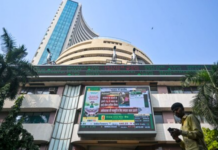

New Delhi— Indian equity markets ended sharply lower on Friday amid rising geopolitical tensions between Israel and Iran and a sharp spike in global crude oil prices, triggering widespread risk aversion among investors.
The benchmark BSE Sensex plunged as much as 1,339 points during early trade, hitting an intra-day low of 80,354.59, before partially recovering to close at 81,118.60 — down 573.6 points or 0.70 percent.
The NSE Nifty also fell sharply, ending the day at 24,718.60, down 169.6 points or 0.68 percent.
“Nifty continued to show weakness on Friday amidst geopolitical tension between Israel and Iran and rising international crude oil prices,” said Nagaraj Shetti, Technical Research Analyst at HDFC Securities. He noted that the current chart pattern indicates a short-term top reversal, although the medium-term outlook remains positive.
Among the 30 Sensex stocks, top laggards included ITC, IndusInd Bank, State Bank of India, and HDFC Bank, each dropping over 1 percent. On the upside, Tech Mahindra, TCS, Sun Pharma, and Maruti Suzuki managed to post modest gains.
The broader market also remained under pressure. The Nifty Midcap 100 index slipped 0.24 percent, while the Nifty Smallcap 100 declined by 0.43 percent, reflecting widespread selling across segments.
Sectoral performance was mixed, with public sector banks and FMCG companies leading the decline. The Nifty PSU Bank and Nifty FMCG indices each dropped over 1 percent. Other sectors such as metals, financial services, auto, energy, pharma, consumer durables, and oil & gas also closed in the red.
Geopolitical concerns also fueled a jump in crude oil prices. WTI crude surged 8.57 percent to $73.87 per barrel, further weighing on market sentiment. Meanwhile, the India VIX — a key gauge of market volatility — spiked 7.6 percent to 15.08, signaling heightened investor anxiety.
“Market sentiment was notably impacted by heightened geopolitical tensions following Israel’s military strike on Iran, which significantly increased risk aversion among investors,” said Vinod Nair, Head of Research at Geojit Financial Services.
Analysts expect elevated volatility to persist in the near term as global tensions and commodity price swings continue to influence investor behavior. (Source: IANS)