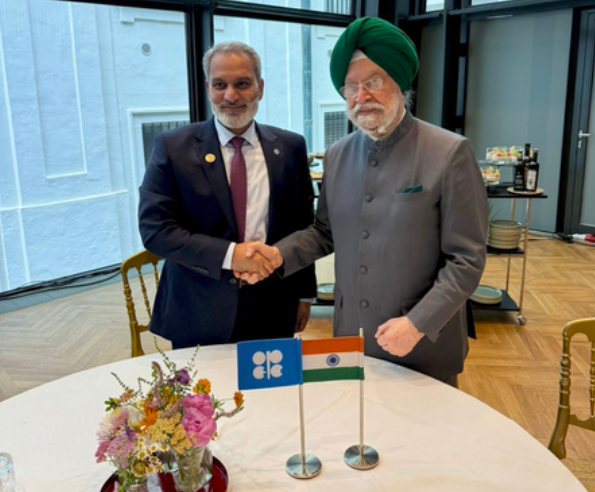
Vienna– Union Minister of Petroleum and Natural Gas Hardeep Singh Puri on Wednesday highlighted the strong and evolving partnership between India and OPEC, underscoring the need for balanced oil markets to support a smooth global transition to green and alternative energy sources.
Puri met with OPEC Secretary General Haitham Al-Ghais on the sidelines of the 9th OPEC International Seminar in Vienna.
“We discussed India’s strong partnership with OPEC and ways to ensure that oil markets remain balanced and predictable to enable a smooth global transition to green and alternative energies, especially in light of recent geopolitical challenges,” the minister posted on X (formerly Twitter).
As the world’s third-largest oil importer, India shares a unique and mutually beneficial relationship with OPEC, the bloc of major oil-producing nations, he said.
In his address at the seminar, Puri stressed that while India’s drive for energy security continues to accelerate, the country remains focused on ensuring accessible and affordable energy for all its citizens.
He highlighted the success of the Pradhan Mantri Ujjwala Yojana (PMUY), the government’s flagship clean cooking initiative. “More than 103 million LPG connections have been provided to women from economically weaker households,” Puri said. “It’s the world’s largest clean cooking program and has significantly improved energy access and public health outcomes.”
As a result of this initiative, LPG coverage in India has grown from just 55 percent in 2014 to near-universal access today. Notably, LPG prices for PMUY beneficiaries remain among the lowest globally.
Puri noted that despite a sharp 58 percent rise in international LPG prices, PMUY consumers in India currently pay only $6–$7 for a 14.2 kg cylinder — approximately 39 percent less than the $10–$11 they paid in July 2023. This affordability is made possible by substantial government subsidies and financial losses absorbed by oil marketing companies (OMCs), which together incurred losses of $4.7 billion last year to stabilize prices. (Source: IANS)