NEW DELHI— India made a strong impression at the United Nations this week by presenting its third Voluntary National Review (VNR) report on the Sustainable Development Goals (SDGs) during the ministerial segment of the High-Level Political Forum convened by the UN Economic and Social Council.
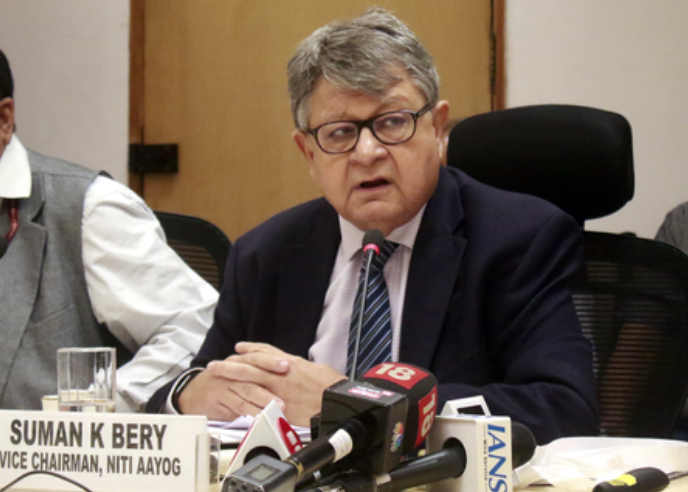
The report, presented by NITI Aayog Vice Chairman Suman Bery, highlights India’s integrated approach to sustainable development, grounded in both governmental coordination and societal engagement.
“This was an important opportunity to share with the world how India’s combination of economic growth, infrastructure investment, targeted welfare delivery, and grassroots participation has transformed the SDGs into a national movement within a decade,” Bery said.
The preparation of the VNR 2025 was led by NITI Aayog through a consultative and data-driven process involving state governments, Union Territories, civil society organizations, development partners, and the private sector. UNDP played a key role in supporting this effort, particularly in helping establish SDG Coordination and Acceleration Centers across India to strengthen local implementation.
The report reaffirms India’s enduring commitment to the UN’s 2030 Agenda and captures ten years of decisive policy action that has delivered transformative outcomes across multiple domains.
Among the key achievements outlined are the elevation of approximately 248 million people from multidimensional poverty and the delivery of food security through the Pradhan Mantri Garib Kalyan Anna Yojana, which provided vital nutrition support to millions during times of need.
Other major initiatives spotlighted include POSHAN Abhiyaan and Ayushman Bharat, which have improved access to nutrition and healthcare, and clean energy programs like the National Green Hydrogen Mission, PM-KUSUM, and PM Surya Ghar Muft Bijli Yojana, which are accelerating India’s shift toward sustainable energy.
India also emphasized its emergence as the world’s third-largest startup ecosystem and the transformative impact of infrastructure-focused programs such as PM Gati Shakti, Make in India, and the National Industrial Corridor Development Programme.
The VNR further underscores India’s pioneering work in building Digital Public Infrastructure (DPI) through the Jan Dhan-Aadhaar-Mobile (JAM) trinity, now recognized globally as a model for inclusive and transparent governance.
To localize and track SDG progress, India continues to deploy tools such as the SDG India Index, the North Eastern Region District SDG Index, and the National Multidimensional Poverty Index. Ground-level initiatives like the Aspirational Districts Programme (ADP) and Aspirational Blocks Programme (ABP) are designed to ensure saturation of government services in underdeveloped areas.
India’s VNR 2025 also highlights its increasing leadership in South-South Cooperation, offering capacity-building and institutional support to fellow developing nations as part of its role as a trusted global development partner.
The report aligns the SDG goals with India’s long-term development vision, Viksit Bharat@2047, emphasizing a future driven by inclusion, innovation, and institutional strength. (Source: IANS)