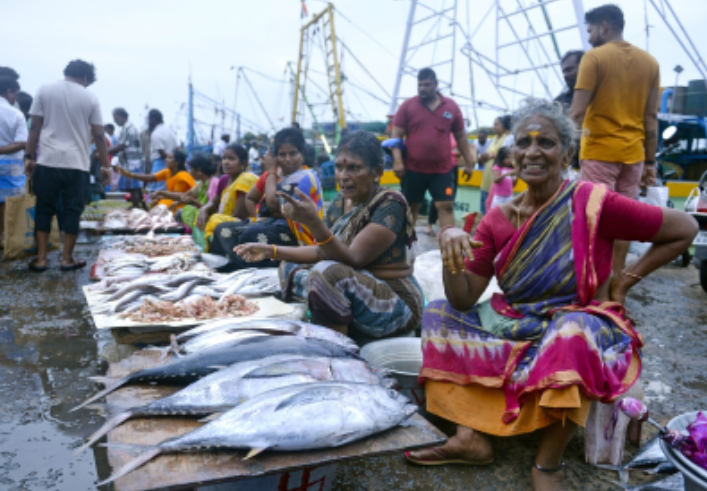
NEW DELHI– Five years after its launch, Prime Minister Narendra Modi’s flagship Pradhan Mantri Matsya Sampada Yojana (PMMSY) has transformed India’s fisheries sector, making the country the world’s second-largest fish producer and ushering in what officials call a “Blue Revolution.”
According to government data released Tuesday, India achieved record fish production of 19.5 million tonnes in 2024–25, up sharply from 14.16 million tonnes in 2019–20. That output now accounts for nearly 8 percent of global fish production. Average aquaculture productivity has also risen significantly, climbing from 3 tonnes per hectare to 4.7 tonnes per hectare as of February 2025.
Exports from the sector have surged as well, rising from Rs 46,662.85 crore in 2019–20 to Rs 60,524.89 crore in 2023–24, bolstering India’s profile in the global seafood market.
The program has been a major job creator, generating 5.8 million employment opportunities as of December 2024 — surpassing its initial target of 5.5 million. Women have also benefited directly, with 99,018 participants supported through Rs 4,061.96 crore in sanctioned projects between 2020–21 and 2024–25. Under PMMSY, women can receive up to 60 percent of the total project cost — capped at Rs 1.5 crore — for beneficiary-oriented and entrepreneurial ventures.
Beyond boosting production and exports, the scheme has prioritized sustainability. The Department of Fisheries has identified 100 coastal villages to become Climate Resilient Coastal Fishermen Villages, designed to withstand environmental challenges while remaining economically viable. Technology adoption has also expanded, with the approval of more than 52,000 reservoir cages, over 22,000 Recirculatory Aquaculture System (RAS) and Biofloc units, and more than 1,500 sea cages, representing a total investment of Rs 3,040.87 crore.
To strengthen supply chains and reduce post-harvest losses, PMMSY has directed Rs 3,281.31 crore toward the development of 58 fishing harbors and landing centers. Additional allocations include Rs 1,568.11 crore for cold storage facilities, 21 wholesale markets — including three smart markets — nearly 200 retail markets, over 6,400 fish kiosks, and more than 27,000 fish transport units. The scheme has also promoted digital platforms, with five e-marketplaces dedicated to fish trade.
Furthermore, 2,195 fisheries cooperatives have been supported as Fish Farmers Producer Organizations (FFPOs), with a combined project outlay of Rs 544.85 crore, aimed at improving bargaining power, market linkages, and long-term sector sustainability.
Government officials say the scheme has not only fueled economic growth but also positioned India as a leader in sustainable and inclusive aquaculture practices. (Source: IANS)