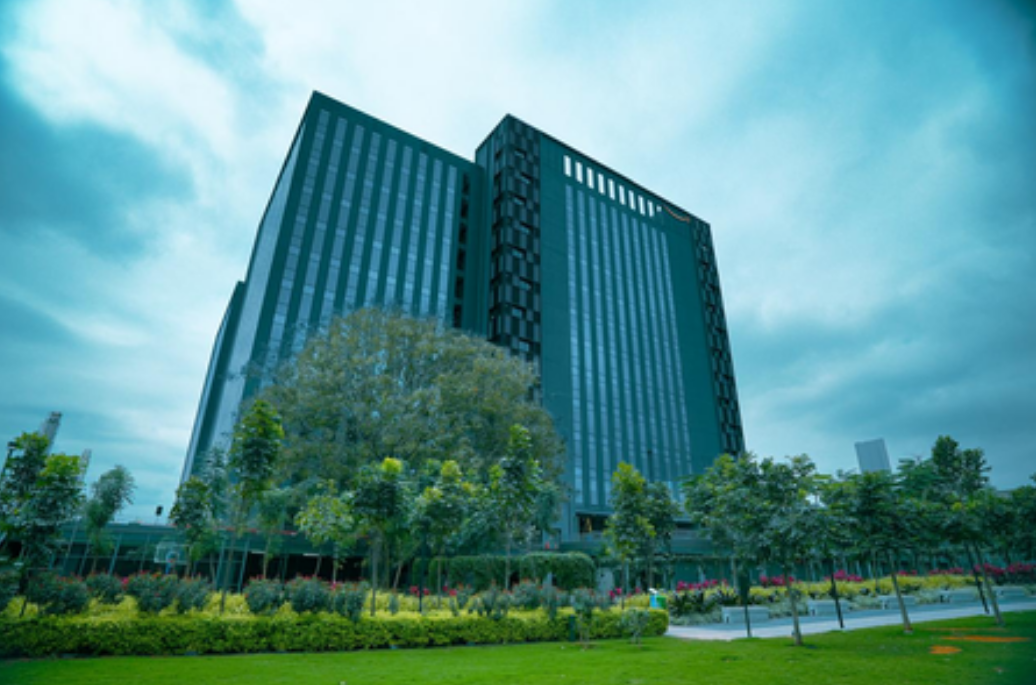
NEW DELHI — Amazon on Monday announced the opening of its second-largest office in Asia in Bengaluru, marking a major expansion of the U.S. technology giant’s physical footprint in India.
The new 12-story campus spans about 1.1 million square feet and is designed to support more than 7,000 employees across e-commerce, operations, payments, technology and seller services, the company said.
Karnataka Minister for Large and Medium Industries and Infrastructure Development M.B. Patil, who inaugurated the facility, said Amazon’s continued investment underscores India’s growing importance as a global technology and innovation hub.
“Large-scale campuses like Amazon’s new campus create high-quality jobs, strengthen the local ecosystem, and support India’s digital economy,” Patil said, adding that the state welcomes long-term investments that build workforce capability and expand opportunity.
The new office is part of Amazon’s broader investment strategy in India. The company has already invested more than $40 billion in the country and has committed an additional $35 billion in investments by 2030.
Located about 15 kilometers from Kempegowda International Airport, the Bengaluru campus has been designed to bring teams together at scale while enabling collaboration, flexibility, learning and employee wellbeing, the company said.
“Over the years, the city has been home to some of our earliest technology and business teams, and today it remains a key hub for innovation and talent,” said Samir Kumar, Country Manager for Amazon India.
The campus features adaptable workspaces and collaborative zones organized into self-sustaining neighborhoods, including meeting rooms, huddle spaces, breakout areas and event spaces capable of hosting more than 200 people.
Employees also have access to a range of recreational amenities, including basketball and pickleball courts, an amphitheater, landscaped lawns and outdoor community spaces. Cafeterias spread across two floors offer a variety of global cuisines.
Amazon said the project incorporates sustainability-focused strategies such as responsible material sourcing, reuse of office assets and high-efficiency systems aimed at reducing both embodied and operational carbon. (Source: IANS)