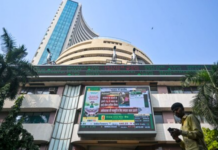

MUMBAI, Maharashtra — Indian equity markets closed sharply higher on Monday for a second straight session, supported by positive sentiment following the announcement of an interim framework for the India–U.S. trade deal.
The benchmark Sensex advanced 485 points, or 0.58 percent, to close at 84,065, while the Nifty rose 173 points, or 0.68 percent, to settle at 25,867.
Broader markets outperformed the frontline indices, with the Nifty Midcap 100 climbing 1.58 percent and the NSE Smallcap 100 surging 2.64 percent. Gains were also supported by firm cues from other Asian markets, which helped sustain momentum through the trading session.
Buying interest was seen across multiple sectors, including public sector banks, consumer durables, real estate, defence, pharmaceuticals and automobiles. Information technology stocks, however, showed mixed performance as investors continued to assess global technology developments.
All sectoral indices ended in positive territory. Nifty Media led the gains, rising 4.37 percent, followed by Nifty Consumer Durables, which climbed 3.60 percent. Nifty PSU Bank advanced 3.34 percent, Nifty Realty gained 2.61 percent and Nifty Metal added 1.56 percent.
Market analysts said participation remained selective after a strong opening, as investors avoided aggressive positioning ahead of key global and domestic macroeconomic indicators.
They added that the market appears to be in a phase of gradual recovery and consolidation, with near-term direction likely to be influenced by global economic trends, currency movements and the sustainability of risk-on sentiment reflected in foreign fund flows.
The Indian rupee strengthened 0.12 percent against the U.S. dollar to close at 90.68 per dollar.
According to market watchers, immediate support for the Nifty is seen in the 25,550–25,600 range, followed by a stronger demand zone near 25,450–25,500. Bank Nifty continues to consolidate in the 60,500–60,700 range, indicating healthy absorption of recent gains rather than distribution. (Source: IANS)