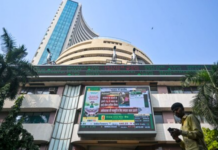

MUMBAI, India — Indian stock markets rallied sharply on Tuesday, with benchmark indices closing near their session highs as investor sentiment improved on signs of easing geopolitical tensions and strong buying in auto and banking stocks.
The Nifty jumped 399.75 points, or 1.78 percent, to settle at 22,912.40, while the Sensex surged 1,372.06 points, or 1.89 percent, to end the day at 74,068.45.
Market participants pointed to improving global cues, particularly expectations of reduced tensions between the United States and Iran, as a key driver of the rally, even as signals from both sides remained mixed.
From a technical perspective, analysts said the Nifty is showing early signs of a short-term recovery, supported by easing geopolitical pressures and a strong gap-up opening.
“On the downside, 22,700 now acts as an immediate support backed by OI build-up, while the 22,500–22,600 zone continues to be a critical demand area where buying interest is expected to emerge,” an analyst said.
Broader markets also advanced in line with the benchmarks. The Nifty MidCap index rose 2.60 percent, while the Nifty SmallCap index gained 2.63 percent.
Sector-wise, media stocks led the rally, with the Nifty Media index climbing more than 3 percent. Auto and banking stocks also posted strong gains, contributing significantly to the market’s upward momentum.
Pharma stocks, however, underperformed compared to other sectors, registering the smallest gains during the session.
Analysts said the market’s rise reflected improving investor confidence, supported by sectoral strength and reduced concerns over global risks.
“The recovery was largely driven by a moderation in risk perception, as early signs of potential de-escalation in the ongoing U.S.–Iran tensions helped restore some investor confidence,” a market expert said.
Meanwhile, the Indian rupee weakened to around 93.90 against the U.S. dollar, down 0.36 percent, as continued tensions in West Asia and rising crude oil prices weighed on sentiment and added pressure to the country’s import outlook. (Source: IANS)