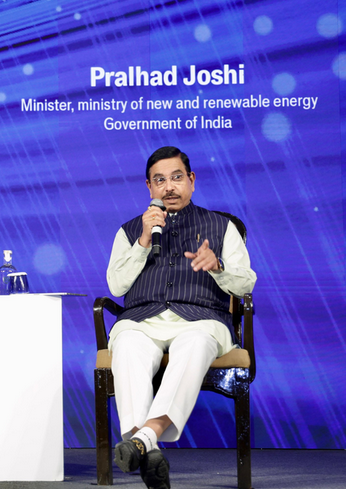
NEW DELHI — India is stepping up its transition to clean energy, aiming to reach 500 gigawatts (GW) of installed power capacity by 2030, Union Minister Pralhad Joshi said Wednesday.
Speaking on the sidelines of the Resilient Futures Summit 2026 in the national capital, Joshi said the country has made rapid progress in expanding renewable energy under Prime Minister Narendra Modi.
He said India has already achieved its goal of sourcing 50 percent of its electricity from non-fossil fuel sources five years ahead of schedule, highlighting what he described as the government’s ability to exceed its own targets.
According to Joshi, nearly 30 percent of India’s electricity is currently generated from renewable sources such as solar, wind, battery storage, and pumped storage.
He added that during recent peak demand periods, close to two-thirds of the country’s electricity needs were met through renewable energy, reflecting both increased generation capacity and improvements in transmission infrastructure.
Joshi called the progress a “success story,” saying India is aggressively expanding its energy capacity and remains on track to meet key milestones by 2027. While a substantial amount of capacity has already been installed, he noted that further expansion will be driven through a utility-led model.
The minister also pointed to strong momentum in solar and green energy projects, with several large-scale developments underway that are expected to support continued growth in the sector.
Earlier this month, Joshi said India recorded its highest-ever annual increase in wind energy capacity, adding 6.1 GW during the 2025–26 period.
India currently ranks fourth globally in wind energy, with more than 56.1 GW of installed capacity and an additional 28 GW under implementation, he said at an industry event. (Source: IANS)