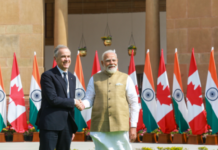

NEW DELHI, India — As global trade faces turbulence from shifting alliances, supply disruptions, and renewed tariff tensions with the United States, the proposed India–European Union Free Trade Agreement (FTA) is emerging as a key pillar for equitable growth and long-term strategic cooperation between the two economies.
According to a report by Greece’s digital outlet NewsBomb, the India–EU pact represents more than a commercial opportunity—it carries significant geopolitical weight. For the European Union, confronting sluggish recovery, U.S. protectionism, and dependence on limited supply chains, India offers diversification, reliability, and a rapidly expanding market.
For India, the agreement promises to sharpen competitiveness, attract quality investment, and open access to advanced technologies and premium markets. Against a backdrop of war in Ukraine, volatile energy prices, and shifting security blocs, the FTA is expected to provide a stabilizing influence and help build mutual resilience.
The EU remains one of India’s strongest trade partners. Bilateral goods trade has jumped nearly 36 percent over five years, from $90 billion in 2020–21 to $136 billion in 2024–25—outpacing India’s trade growth with the United States. This surge underscores Europe’s growing role in India’s external economic strategy.
India’s exports to Europe now blend traditional labor-intensive products such as textiles, footwear, and jewelry with higher-value goods like electronics, machinery, pharmaceuticals, and organic chemicals. These top twenty export categories together make up more than 83 percent of total shipments to the EU.
On the import side, Europe remains a major source of high-technology components and industrial equipment, including nuclear reactors, electrical machinery, and renewable-energy technologies that align with India’s Make in India and Atmanirbhar Bharat initiatives.
Investment flows are robust in both directions. The European Union has invested over $117 billion in India, while Indian companies have deployed about $40 billion across European markets, especially in pharmaceuticals, IT, and clean energy.
Negotiators have already made substantial progress on customs facilitation, intellectual property rights, transparency, and dispute settlement. Both sides are pushing to finalize the agreement by December 2025—marking what could become one of India’s most comprehensive and forward-looking trade partnerships. (Source: IANS)