
NEW DELHI — The Indian Commerce Ministry is preparing to significantly accelerate its trade agenda in the coming months, with high-level negotiations scheduled to begin in January to secure expansive market access with Israel and the Eurasian Economic Union (EAEU). These dual tracks represent a strategic effort by New Delhi to diversify its export destinations and solidify long-term economic partnerships in the technology, defense, and energy sectors.
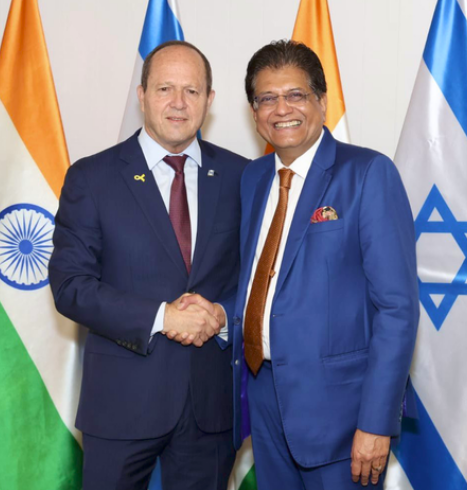
Commerce Ministry officials are slated to meet with Israeli counterparts in January to navigate the complexities of a bilateral Free Trade Agreement (FTA). This follows a framework established in November when Indian Commerce Minister Piyush Goyal and Israel’s Economy Minister Nir Barkat signed the terms of reference in Tel Aviv. The upcoming January sessions will focus on resolving framework and gateway issues in pre-round negotiations. The objective is to move beyond the preliminary stages and finalize a comprehensive pact designed to catalyze investment and technical cooperation in agriculture and defense.
Parallel to the Israel track, India is deepening its engagement with the EAEU—a five-nation economic bloc consisting of Russia, Belarus, Kazakhstan, Armenia, and Kyrgyzstan. After the presentation of the Union Budget on February 1, an Indian negotiating team is expected to travel to Russia for a second round of talks regarding an India-EAEU free trade agreement. The EAEU serves as a unified market promoting the free movement of goods, services, capital, and labor, and New Delhi views the bloc as a critical gateway for expanding its footprint in Central Asia and Eastern Europe.
A central priority for the Indian delegation will be the reduction of non-tariff barriers that have historically hampered Indian exports to the region. Exporters currently face a difficult landscape of regulatory overlap between Russian, EAEU, and European standards. New Delhi is seeking to harmonize these rules, particularly regarding labeling requirements for products destined for the Russian market, to ensure greater transparency and ease of entry.
The broader ambition for the Indo-Russian corridor is to scale bilateral trade to $100 billion by 2030. While energy remains a cornerstone of this relationship, the focus is shifting toward a more balanced trade profile. Russia has already begun relaxing import requirements for Indian marine products, signaling a willingness to reduce barriers and enhance connectivity for smoother commerce across the bloc. (Source: IANS)