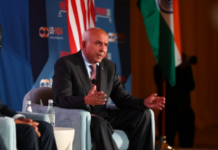


Washington — India’s rapidly expanding economy could drive its energy demand to triple over the next 25 years, creating major opportunities for U.S. investment, technology partnerships and energy cooperation, industry leaders said.
Speaking during an energy security and infrastructure panel at the U.S.-India Strategic Partnership Forum Leadership Summit, ExxonMobil Director of Economics and Energy Prasanna Joshi said India’s growth outlook stood apart from that of other major economies.
“Our outlook is projecting that the global GDP will essentially double in the next 25 years, whereas India… going almost a factor of seven to eight times… to 25 to 30 trillion dollars,” Joshi said. “Energy demand is expected to grow only about 12 to 15 per cent in the next 25 years. For India, that number is a factor of three.”
Joshi said India’s growth plans would require massive investment across the energy sector and would depend on a broad mix of energy sources to support economic expansion and maintain energy security.
India currently has about 500 gigawatts of installed electricity generation capacity and aims to increase that figure to roughly 2,100 gigawatts by 2047, he said.
Renewable energy is expected to account for a significant share of that expansion.
“The projection for solar and wind is… 100 gigawatts have to go to about 1,800 gigawatts… there’s so much opportunity for investment and opportunity for collaboration in India,” Joshi said.
He added that conventional energy sources would continue to play an important role in meeting India’s needs.
“Only 10 per cent of India’s resources have been explored,” he said, adding that increased exploration could strengthen the country’s energy security.
Natural gas currently accounts for about 6 percent of India’s energy mix, Joshi said. India is seeking to raise that share to between 12 percent and 15 percent by 2047 through infrastructure development, exploration and long-term investment.
Ernie Thrasher, president and CEO of Xcoal Energy & Resources, said India had become the largest overseas market for U.S. coal exports.
“India as a destination is the largest consumer of US export coal. Currently approximately 23 per cent of US coal exports,” Thrasher said.
U.S. coal exports to India increased from 1 million metric tons in 2005 to 21.5 million metric tons last year, he said.
“So the growth is phenomenal,” Thrasher said.
He said India’s growing energy requirements could not be met by a single source.
“India and the world needs all forms of energy today. One form of energy by itself is not going to solve the world’s sensational demand for energy and electricity,” Thrasher said.
He also highlighted opportunities for U.S. companies in underground mining, coal gasification, battery storage and other energy technologies.
Both speakers described India as one of the world’s largest long-term investment opportunities, but said the scale of the country’s infrastructure expansion would require cooperation among governments, businesses and technology providers.
“This cannot be done by a single entity. You have to collaborate across the entire value chain,” Joshi said.
He said India’s large domestic market would be one of its greatest strengths.
“India’s growth is going to come from internal… That’s what we can tap into is the consumer base in India,” Joshi said.
Thrasher said investors would need to take a long-term approach while keeping energy affordable.
“We need a long-term horizon to make those energy investments and we need to focus on keeping the cost at a level that the Indian economy can,” he said.
Affordable energy will remain essential as India works to raise living standards for its large population, Thrasher added.
The discussion was held during the ninth USISPF Leadership Summit in Washington, which brought together senior government officials, diplomats and business leaders from India and the United States to discuss cooperation in trade, energy, technology and other strategic sectors.
India and the United States have expanded energy cooperation in recent years in areas including liquefied natural gas, civil nuclear power, renewable technologies, critical minerals and clean energy innovation. (Source: IANS)