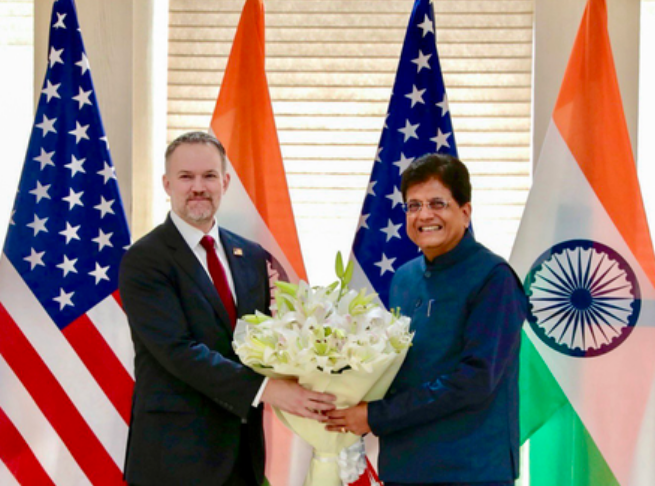

New Delhi — India and the United States are expected to push forward negotiations on a proposed bilateral trade agreement during Commerce and Industry Minister Piyush Goyal’s visit to the United States this week.
Goyal is scheduled to meet U.S. Trade Representative Jamieson Greer as the two countries work toward a balanced and mutually beneficial trade pact.
India is seeking preferential tariff treatment that would give its exporters an advantage over competing economies rather than simply securing a lower headline tariff rate.
Goyal will attend the G20 Trade Ministers’ Meeting in Milwaukee, Wisconsin, on Sept. 30 and Oct. 1 at the invitation of the U.S. Trade Representative.
According to an official statement, India and the United States will work toward finalizing an interim trade agreement in line with the joint statement issued by the two countries on Feb. 7, 2026.
India is also expected to emphasize the importance of a rules-based, open, inclusive, transparent, equitable and non-discriminatory global trading system with the World Trade Organization at its core.
Commerce Secretary Rajesh Agrawal said earlier this month that the proposed India-U.S. trade deal had been largely finalized, with the two sides now working on a framework to provide preferential market access before formally signing the agreement.
Agrawal said the countries need to establish a mechanism that ensures preferential access to each other’s markets.
He said India largely operates under most-favored-nation tariff rules, while the United States is currently using executive tariffs, making it necessary to create a structure that provides tariff differentials for Indian exporters.
During his U.S. visit, Goyal is also expected to hold a series of bilateral meetings aimed at strengthening trade and investment ties.
The discussions are expected to include opportunities for farmers, fishermen, women entrepreneurs, startups, micro, small and medium-sized enterprises and other businesses.
Goyal is also scheduled to meet senior executives from major U.S. companies in manufacturing, consumer goods, agribusiness, retail and technology during stops in Milwaukee and Chicago. (Source: IANS)