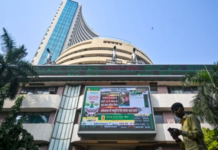

Mumbai — Indian stock markets closed lower for the fourth consecutive trading session Friday, as escalating geopolitical concerns dampened investor confidence and triggered widespread selling, particularly among mid-cap and small-cap stocks.
The benchmark BSE Sensex declined 125.56 points, or 0.17%, to close at 73,123.83, while the NSE Nifty 50 fell 87.65 points, or 0.39%, to finish at 22,600.00.
Although the benchmark indices recovered from their intraday lows, market sentiment remained cautious as investors reduced exposure to riskier assets amid growing uncertainty over global developments.
The selling was considerably more pronounced in the broader market, where smaller companies suffered sharper losses than their large-cap counterparts.
The Nifty MidCap 100 index dropped 2.21%, while the Nifty SmallCap 100 index plunged 2.94%, reflecting widespread weakness across the market.
Among individual Nifty stocks, Shriram Finance and JSW Steel were among the biggest decliners, contributing to the benchmark’s losses.
Metal producers and financial companies faced sustained selling pressure, while real estate and public-sector banking stocks also recorded significant declines.
The Nifty Metal, Nifty Realty and Nifty PSU Bank indices ranked among the day’s worst-performing sectoral benchmarks as investors pulled back from industries considered particularly sensitive to economic conditions.
Information technology stocks, however, showed relative resilience during the session.
The Nifty IT index recorded the smallest losses among major sectoral indices, helping limit the overall decline in the broader benchmarks.
Market analysts said the Nifty’s recovery from its intraday low suggested buying interest around the 22,400 to 22,500 range, although the index’s closing level of 22,600 indicated that sentiment remained fragile.
“Holding 22,500 could trigger a mean-reversion rebound toward 22,800–22,900, but a break below it may expose 22,300 and 22,200. Only a sustained close above 22,900 would indicate that the current decline is beginning to stabilise,” analysts said.
The technical outlook suggests that the 22,500 level could serve as an important near-term support point, while a sustained recovery above 22,900 may be necessary to signal a more durable improvement in market conditions.
Analysts attributed the continuing weakness to concerns over geopolitical developments, which have encouraged investors to adopt a defensive approach despite company-specific earnings announcements and other domestic market developments.
They also cautioned that inflation trends and monetary policy decisions by major central banks could play a significant role in determining the direction of equity markets in the coming weeks.
“Going forward, inflation trends and the response of major central banks in balancing inflation and growth will be critical to market direction. In this environment, we expect stock- and sector-specific opportunities to dominate, with earnings visibility and valuation comfort emerging as the key differentiators,” analysts said.
With Indian equities extending their losing streak to four sessions, investors are expected to focus increasingly on corporate earnings, valuations and global economic developments for signs of market stabilization. (Source: IANS)