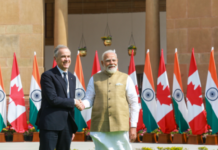

TEL AVIV — Prime Minister Narendra Modi and Israeli Prime Minister Benjamin Netanyahu on Thursday underscored the need to unlock the full potential of bilateral trade and investment, as the two leaders concluded a summit aimed at expanding economic and technology cooperation.
In a joint statement issued after the talks, the leaders reaffirmed their commitment to integrating India’s and Israel’s strengths across key sectors, including artificial intelligence, cybersecurity, semiconductors, quantum computing, biotechnology, agriculture, water management, defense platforms and space exploration.
The partnership, they said, aligns with India’s vision of “Atmanirbhar and Viksit Bharat 2047” and is intended to drive the next phase of technological transformation and shared economic growth. The statement noted that Israel’s global leadership in technology and innovation complements India’s talent pool, manufacturing capacity and entrepreneurial ecosystem.
Both leaders welcomed the signing of the India-Israel Bilateral Investment Agreement by the two finance ministers in New Delhi in September 2025, describing it as a step toward enhancing investor confidence, promoting two-way investments and ensuring transparency and predictability through a clear framework and independent dispute resolution mechanism.
Modi and Netanyahu also reiterated their commitment to concluding a Free Trade Agreement and directed negotiating teams to expedite discussions for an early signing.
The leaders highlighted cooperation in the financial-cyber domain, with plans to enhance resilience in the financial ecosystem through intelligence sharing, joint methodologies and multilateral financial-cyber simulations coordinated by the two countries’ Financial Computer Security Incident Response Teams.
Netanyahu praised India’s fintech progress, particularly the Unified Payments Interface, calling it a world-class model for affordable, real-time cross-border transactions. Both sides agreed to explore linking UPI with Israel’s fast payment system to boost interoperability and strengthen economic ties.
Direct air connectivity was identified as essential to scaling up bilateral engagement. The leaders expressed a desire to expand direct flights between Tel Aviv and major Indian cities and encouraged airlines from both countries to initiate more direct operations.
The two sides welcomed the launch of the India–Israel Financial Dialogue and encouraged greater Indian participation in Israel’s infrastructure projects, including metro systems, rail, roads, airports, desalination plants and wastewater treatment facilities.
They reviewed the progress of the India-Israel Industrial R&D and Innovation Fund, jointly implemented by India’s Department of Science and Technology and the Israel Innovation Authority, and agreed to strengthen its operational framework to facilitate high-quality joint research and development partnerships.
Acknowledging the success of the India-Israel Joint Research Calls, implemented by India’s Department of Science and Technology and Israel’s Ministry of Innovation, Science and Technology, the leaders agreed to increase funding contributions from $1 million to $1.5 million each.
Both prime ministers emphasized the importance of institutional mechanisms to support joint innovation. They agreed to explore the development of “Tech Gateway” frameworks to promote collaborative R&D initiatives, pilot projects, technology validation and joint development between the two innovation ecosystems.
Artificial intelligence was identified as a strategic priority. The leaders welcomed the signing of a memorandum of understanding on AI cooperation and committed to deepening collaboration in AI talent development, research partnerships and professional exchanges.
The summit also highlighted ongoing cooperation between the Israel Space Agency and the Indian Space Research Organisation. The leaders stressed the importance of encouraging joint ventures, innovation partnerships and knowledge exchange in the space sector.
On sustainable development, Modi and Netanyahu reaffirmed their commitment to strengthening collaboration in water and agriculture. Priority areas include water conservation, wastewater treatment and reuse, desalination, water utility reforms and the use of advanced technologies to clean the Ganges and other rivers.
The leaders said the expanded partnership across trade, technology and innovation reflects a shared commitment to long-term strategic cooperation and mutual growth. (Source: IANS)