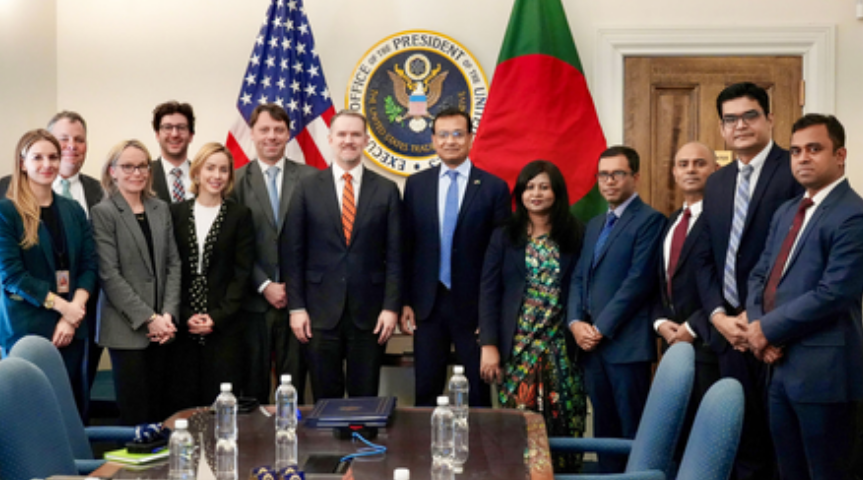

NEW DELHI — Bangladesh’s recent trade and defense arrangements with the United States are raising concerns among some observers who say the agreements could make the country more dependent on American supply chains, defense systems and dollar-denominated purchases.
An article in Dhaka’s The Daily Star argued that the U.S.-Bangladesh trade deal resembles “colonial economics,” comparing it to the way Britain used India’s economy before independence.
The article said the deal allows Bangladeshi garment exports to enter the U.S. market duty-free, but requires those goods to be produced with cotton and fiber imported from the United States.
That condition could make Bangladesh’s garment sector increasingly dependent on U.S. cotton supplies, agricultural policies, subsidies and pricing, according to Moshahida Sultana, an associate professor at Dhaka University.
If U.S. cotton policy changes, supplies are redirected to other markets or new conditions are imposed, the impact could be felt directly by Bangladeshi factories, workers and lenders, the article said.
Sultana compared the arrangement to the 19th-century economic relationship between Lancashire and India, in which India supplied raw materials and became a captive market for finished goods. She argued that “zero duty, but you must use our cotton” agreements tie Bangladesh’s largest export industry to American agricultural and corporate interests.
The article also raised concerns about defense cooperation, saying modern trade and security agreements often pressure countries to buy American surveillance systems, communications equipment and precision munitions.
According to the article, Bangladesh could gradually become tied to a U.S.-controlled defense ecosystem involving American platforms, ammunition, software, encryption and spare parts, all subject to U.S. export licensing.
“Publicly, it is about ‘maritime security’ and ‘threat response’. But the budget books reveal the old colonial logic in a modern uniform: a dependent state’s foreign-exchange reserves used to secure profits for foreign arms companies. The louder the talk of ‘shared security’, the more money drains from Dhaka into distant corporate headquarters,” the article said.
The article also criticized potential aircraft purchases from Boeing, saying such deals could add to Bangladesh’s debt burden even if the planes are presented as part of fleet modernization.
Boeing aircraft purchases are typically priced in dollars and may involve long-term loans or leases, while also tying buyers to American parts, software, maintenance and training, the article said.
The report noted that Bangladesh’s imports of aircraft engines from the United States have already risen from Tk 137 crore to Tk 1,852 crore. It argued that if passenger forecasts prove overly optimistic or the national airline struggles with corruption or inefficiency, the public could still be left responsible for loan repayments.
For a debt-burdened economy, the article warned, such commitments could become a “recipe for a debt trap.” (Source: IANS)