
NEW DELHI — Nearly nine years after India launched its first bullet train project, the Mumbai-Ahmedabad High Speed Rail corridor is showing signs of faster progress, with major construction milestones now completed across the 508-kilometer route.
The project, formally launched in September 2017 by Prime Minister Narendra Modi and then-Japanese Prime Minister Shinzo Abe, remains one of India’s most ambitious rail infrastructure efforts. It is designed to connect Mumbai and Ahmedabad through a high-speed corridor built largely on elevated viaducts, with sections in Maharashtra, Gujarat and Dadra and Nagar Haveli.
Union Railway Minister Ashwini Vaishnaw recently said 349 kilometers of viaduct structure have been completed. The viaduct will carry nearly 90% of the alignment above ground level and is among the project’s most important and costly components.
The government also said 443 kilometers of piers have been erected, while more than 7,700 overhead equipment masts have been installed across 179 kilometers of the alignment. Track bed construction has progressed over 374 track-kilometers, equal to about 187 route-kilometers.
The National High Speed Rail Corporation Ltd., which is implementing the project, has installed more than 570,000 noise barriers across 288 kilometers of the route to reduce the sound impact in populated areas.
Construction has also picked up in Maharashtra, where land acquisition issues and political opposition had slowed the project for years. Officials said 5 kilometers of the 21-kilometer underground tunnel between Mumbai’s Bandra-Kurla Complex and Shilphata have been excavated.
That section includes India’s first undersea rail tunnel, with about 7 kilometers of tunneling planned beneath Thane Creek.
Last week, NHSRCL said the cutter head of India’s largest tunnel boring machine had been lowered into a launch shaft at Vikhroli in Mumbai. The cutter head weighs about 350 tons and measures 13.6 meters in diameter. Vaishnaw described it as the largest cutter head ever used in an Indian railway project.
The Mumbai-Ahmedabad corridor is planned to include 12 stations: Mumbai, Thane, Virar and Boisar in Maharashtra; Vapi, Bilimora, Surat, Bharuch, Vadodara, Anand/Nadiad, Ahmedabad and Sabarmati in Gujarat.
Station construction in Gujarat is at an advanced stage, according to NHSRCL officials. Contracts for station plazas at Surat, Bilimora, Vapi, Bharuch, Anand and Vadodara have been awarded. In Maharashtra, work has begun on all three elevated stations, while foundation work is underway at the underground Bandra-Kurla Complex terminal in Mumbai.
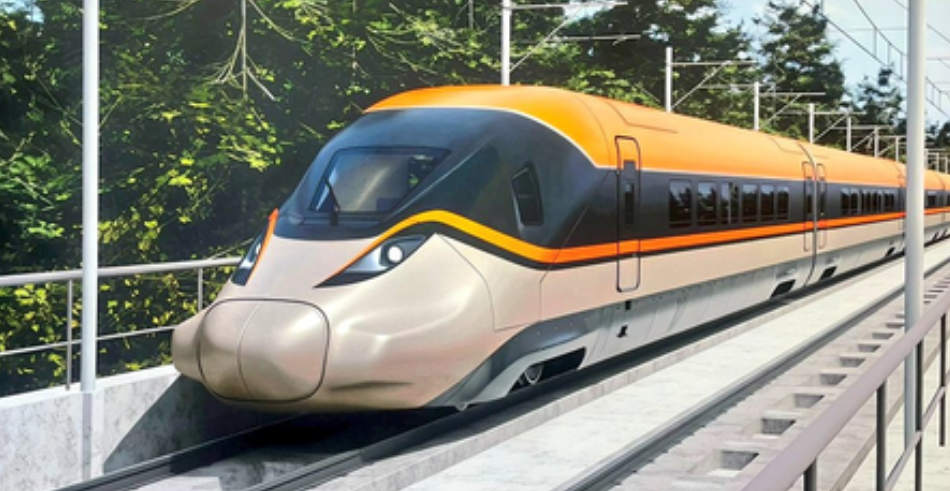
The project is based on Japan’s Shinkansen technology, but India is also moving toward domestic production of high-speed trainsets. In late 2024, the Integral Coach Factory awarded an Rs 867 crore contract to Bengaluru-based BEML to design and manufacture India’s first indigenous high-speed trains for the corridor.
Those trains are expected to operate at about 250 kilometers per hour, with a maximum speed of 280 kilometers per hour. The infrastructure is being designed for speeds of up to 320 kilometers per hour, allowing for faster trainsets later.
Officials are planning two types of services on the route. A faster service would stop only at Surat and Vadodara and could cut travel time between Mumbai and Ahmedabad to just over two hours. An all-stop service is expected to complete the trip in less than three hours.
Current conventional rail services between the two cities take about seven hours. The Ahmedabad-Mumbai Central Vande Bharat Express completes the journey in about five-and-a-half hours, with a top operational speed of 130 kilometers per hour. (Source: IANS)