

NEW DELHI — India’s startup ecosystem has grown from about 350 to 400 startups in 2014 to more than 200,000 today, making the country the world’s third-largest startup ecosystem, Union Minister of State for Science and Technology and Earth Sciences Jitendra Singh said Monday.
Singh said the growth has been driven largely by policy reforms, stronger support for science and technology, greater research freedom and expanded private-sector participation.
India’s ranking in the Global Innovation Index has improved from 80th to 38th, while the country now ranks sixth globally in patents, with more than 100,000 patents filed, Singh said. More than 55% of those filings were made by Indian residents, according to the Ministry of Science and Technology.
The minister said India has also become one of the world’s leading countries in scientific publications and innovation-driven research.
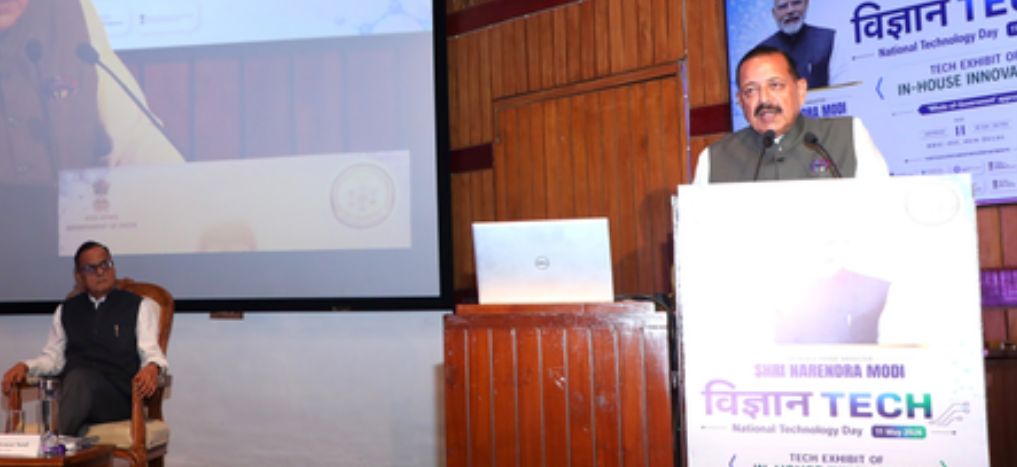
Speaking at the inaugural session of Vigyan TECH 2026, organized for National Technology Day at BRIC-NII, Singh said science and innovation have received unprecedented national priority since 2014, helping accelerate technological progress across multiple sectors.
The event included the release of a compendium showcasing indigenous technologies developed by autonomous institutes and laboratories under participating ministries and departments. It also featured technology transfer initiatives and the exchange of memorandums of understanding.
Singh said several major initiatives launched over the past decade have helped position India among leading scientific nations. He cited the National Quantum Mission, IndiaAI Mission, Anusandhan National Research Foundation, Research Development and Innovation initiative, WISE-KIRAN scheme for women scientists and NIDHI program for startups as examples of government efforts to expand innovation, entrepreneurship and inclusive scientific growth.
He also pointed to administrative reforms designed to give scientific institutions more autonomy and flexibility, including liberalized procurement rules and delegation of Global Tender Inquiry exemption powers to institute directors. Those changes, he said, are intended to speed up research and innovation. (Source: IANS)