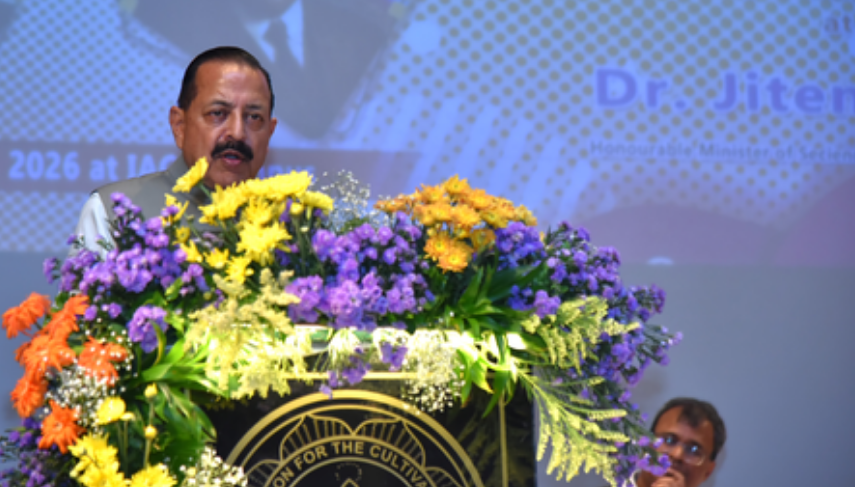
NEW DELHI — Union Minister of State for Science and Technology and Earth Sciences Jitendra Singh inaugurated an indigenously built Plasma Enhanced Chemical Vapor Deposition system at the Indian Association for the Cultivation of Science campus in Kolkata, the government said Tuesday.
The system was developed for the fabrication of India’s first amorphous silicon solar cell, according to the Ministry of Science and Technology. Singh also inaugurated the institute’s new incubation center, RETINA, which stands for Research Entrepreneurship for Translation, Innovation and Navigation.
Singh said the indigenous development of advanced solar-cell fabrication technology reflected the spirit of scientific self-reliance and innovation under India’s “Atmanirbhar Bharat” initiative.
He said the system, built by Prof. Ashok Kumar Barua, helped pioneer amorphous silicon solar-cell development in India and marked an important chapter in the country’s renewable-energy journey.
Speaking at the launch of RETINA, Singh said India’s scientific institutions are increasingly combining fundamental research with entrepreneurship, startup culture and practical applications for society.
He said the future of Indian science will depend on converting laboratory discoveries into affordable and scalable technologies that can address national priorities in health care, clean energy, advanced materials and sustainable development.
Singh praised IACS for its work in quantum materials, nanotechnology, artificial intelligence, battery materials, cancer biology and environmental technologies.
He also cited recent research at the institute in areas including Duchenne muscular dystrophy treatment, toxic waste remediation, photodetectors, biosensors and sustainable energy materials.
Singh said India’s scientific institutions are entering a transformative phase tied to the national vision for Viksit Bharat 2047, with academia, industry, startups and innovation expected to work together to strengthen India’s position as a leading knowledge economy.
He also praised the institute’s outreach initiatives for school students, women and rural communities, saying such efforts help nurture scientific thinking and expand participation in science. (Source: IANS)