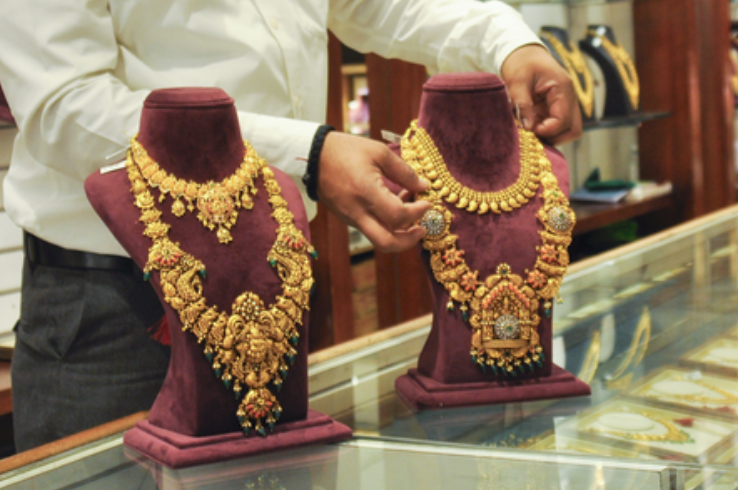
NEW DELHI– Gold has once again outperformed Indian equities, marking the fourth consecutive Diwali-to-Diwali cycle where the yellow metal has delivered stronger returns than stocks. Over the past eight years, gold has outpaced equities in seven of them, cementing its role as a reliable safe-haven asset.
According to data from the India Bullion and Jewellers Association (IBJA), 24-carat gold was priced at Rs 11,431 per gram at 10:05 a.m. on Tuesday. On the Multi Commodity Exchange (MCX), gold has gained about 40 percent since last Diwali, compared with a roughly 5 percent rise in the Nifty 50.
The trend has been consistent in recent years: in 2024, gold returned 32 percent versus the Nifty’s 24 percent; in 2023, gold advanced 21 percent compared to the index’s 10 percent gain. Earlier this month, spot gold touched a record $3,683 per troy ounce — up 43 percent year-to-date — before easing on a firmer-than-expected U.S. Federal Reserve stance.
Analysts said the rally is being fueled by expectations of Fed policy easing, demand for safe-haven assets amid geopolitical and tariff-related uncertainty, and steady central bank buying, particularly in Asia, as countries seek to diversify away from the dollar. Many believe gold could continue to outperform for another year before equities start to narrow the gap.
Silver has also outperformed equities for the third year in a row, supported by industrial demand tied to solar panels, semiconductors, and electric vehicles. IBJA data showed silver priced at Rs 1,34,050 per kilogram at market close Monday.
Wall Street giant Goldman Sachs has projected that gold prices could climb as high as $5,000 per ounce if investors reallocate even a portion of their Treasury holdings into bullion. Softer U.S. labor data and dovish Fed commentary have further reduced the opportunity cost of holding gold, attracting risk-averse investors.
Still, some analysts cautioned that the current rally may be overextended, noting that gold peaked in 2011 before entering a prolonged decline as speculative inflows unwound. (Source: IANS)