
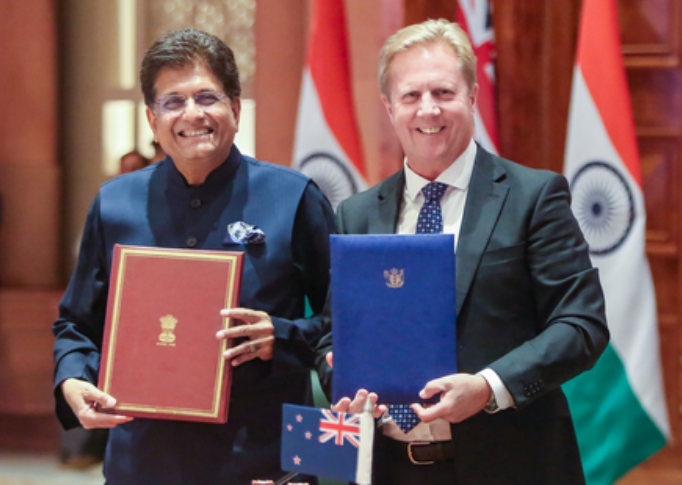

NEW DELHI — The recently concluded India-New Zealand Free Trade Agreement is being viewed as a major step in strengthening economic ties between the two democracies and responding to disruption in global trade, according to international media commentary.
An article in South Africa’s Independent Online described the agreement as a “leap forward in right-setting global trade following US President Donald Trump’s trade war declaration last year.”
Trade between India and New Zealand has grown steadily in recent years, though it remains modest compared with India’s trade with larger partners. Bilateral trade increased from about $900 million in 2019-20 to $1.3 billion in 2024-25.
India’s exports to New Zealand rose from $379 million to $711 million during that period, while imports from New Zealand increased from $522 million to $587 million.
The agreement is expected to accelerate growth by reducing trade barriers and deepening cooperation in investment, services and worker mobility.
India and New Zealand signed the free trade agreement on April 27. The deal removes tariffs on all Indian exports to New Zealand and either eliminates or sharply reduces tariffs on 95% of New Zealand’s exports to India.
The agreement also includes a provision under which New Zealand will invest $20 billion in India over 15 years. The arrangement is similar in structure to the $100 billion investment commitment included in India’s trade agreement with the European Free Trade Association.
The FTA includes measures related to professional and student mobility. New Zealand signed an annex on student mobility and post-study work visas for the first time with any country. Under the provision, Indian students in New Zealand may work up to 20 hours per week while studying and access extended post-study work visas.
The agreement also includes a quota of 5,000 visas for skilled Indians for stays of up to three years in sectors of interest to India. These include AYUSH practitioners, yoga instructors, chefs and music teachers, along with fields such as information technology, engineering, health care, education and construction.
Under the Working Holiday Visa program included in the deal, 1,000 young Indians each year will be able to make multiple entries into New Zealand over a 12-month period.
India has excluded several sensitive products from the FTA, including dairy items such as milk, cream, whey, yogurt and cheese, as well as certain farm products. (Source: IANS)