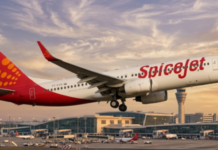


NEW DELHI — The Supreme Court on Tuesday allowed SpiceJet and its chairman, Ajay Singh, to again approach the Delhi High Court seeking modification of an order requiring them to deposit Rs 144.51 crore in a long-running arbitration dispute with Kalanithi Maran and Kal Airways Private Limited.
A bench of Justices P.S. Narasimha and Alok Aradhe disposed of the special leave petition filed by SpiceJet and Singh, permitting them to return to the Delhi High Court in light of recent developments, including the West Asia crisis and the Centre’s Emergency Credit Line Guarantee Scheme 5.0.
The Supreme Court said it was not expressing any view on the merits of the dispute, which remains pending before the Delhi High Court under Section 34 of the Arbitration and Conciliation Act.
Senior advocate Mukul Rohatgi, appearing for SpiceJet, told the court that the aviation sector had been hit hard by the West Asia crisis, including higher fuel prices and operational disruptions. He said SpiceJet, as the smallest player in the sector, was under severe financial pressure and needed more time to clear its dues.
Rohatgi also said the Centre had introduced a bailout and emergency credit line scheme for airlines, with funds expected to be released by November. He told the court that SpiceJet had offered immovable property as security and was taking steps to sell it, but immediate liquidation was not feasible under the Delhi High Court’s order.
The dispute stems from execution proceedings linked to an arbitral award in favor of Maran and Kal Airways. Those proceedings are being heard alongside SpiceJet’s challenge to the award under Section 34 of the Arbitration and Conciliation Act.
The Delhi High Court earlier directed SpiceJet and Singh to deposit Rs 144.51 crore, an order the Supreme Court had previously declined to disturb. SpiceJet and Singh later sought to substitute the cash deposit with immovable property, but the Delhi High Court dismissed those applications on March 18 and rejected review petitions on May 4.
In its petition before the Supreme Court, SpiceJet said hostilities in West Asia had caused “around 35 per cent decrease in operational revenue” because of closures and restrictions involving Middle East airspace. The airline also cited higher aviation turbine fuel prices, longer flight routes and rising insurance costs.
The airline also pointed to the Union government’s May 5, 2026, approval of ECLGS 5.0, saying the scheme was designed to help “eligible borrowers to tide over any short-term liquidity mismatches in view of the West Asia Crisis.”
SpiceJet said it had already paid Rs 729 crore to the respondents, including Rs 579 crore toward principal and Rs 150 crore toward interest. It argued that requiring an immediate cash security deposit of Rs 144.51 crore could hurt airline operations.
Senior advocate Jayant Mehta appeared for the respondents, along with lawyers from Karanjawala & Co. (Source: IANS)