
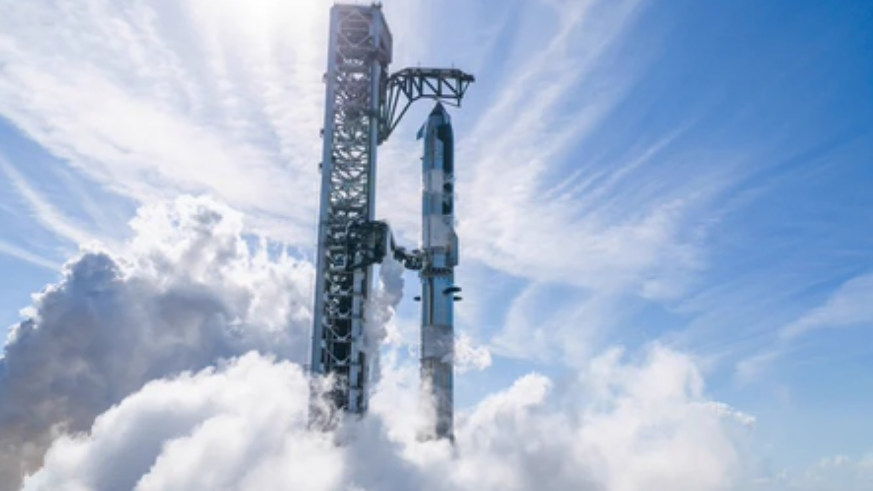

New Delhi — SpaceX’s Starship spacecraft successfully reached orbit Monday and deployed 26 next-generation Starlink satellites, marking another step in the company’s effort to develop a fully reusable launch system for future missions to the Moon and Mars.
The flight encountered a problem during ascent when one of Starship’s six Raptor Vacuum engines shut down. After assessing the condition of the remaining engines, SpaceX engineers continued with the mission.
The spacecraft is expected to complete six orbits around Earth during a roughly 10-hour flight before splashing down in the Pacific Ocean west of Chile, according to the company.
“All 26 Starlink V3 operational satellites deployed and operating nominally,” SpaceX said in a post on X.
Deployment of the satellites was one of the mission’s main objectives. The Starlink V3 spacecraft are the newest generation of satellites in SpaceX’s broadband internet constellation and are designed to increase network capacity, improve reliability and deliver faster connectivity.
SpaceX said each V3 satellite can support up to 1 terabit per second of downlink capacity and 160 gigabits per second of uplink capacity.
That represents about 10 times the downlink capability and 22 times the uplink capacity of the previous Starlink V2 generation, according to the company.
After deployment, the satellites are designed to unfold their antennas, extend their solar arrays and establish communications with ground stations and the broader Starlink network through radio-frequency and laser links.
They will then use onboard thrusters to gradually move into their operational orbits.
SpaceX said the V3 satellites also feature next-generation beamforming chips designed to route data more efficiently across multiple beams. The company said the new technology increases modem throughput capacity by 64 times compared with earlier systems.
The upgrades are intended to allow Starlink to handle growing demand in densely populated areas while also improving service in remote regions and dynamically shifting network capacity where it is needed most. (Source: IANS)