Jaipur — An Air India flight traveling from Frankfurt to New Delhi was cleared to resume its journey Wednesday after a reported hijack alert forced an emergency landing at Jaipur International Airport, prompting an extensive security inspection that found nothing suspicious.
Airport officials said passengers were instructed to reboard flight AI-2030 following security checks, and the aircraft was preparing to depart for Delhi.
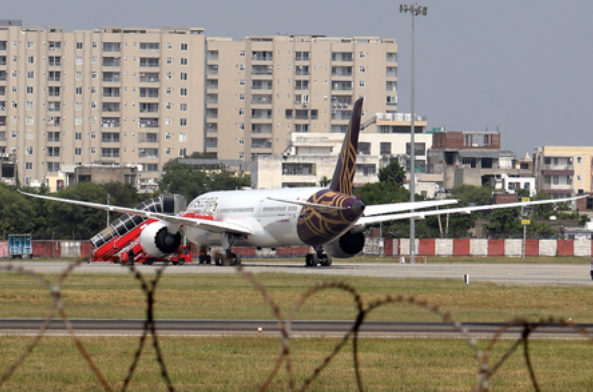
The flight was diverted to Jaipur after air traffic controllers in Ahmedabad reportedly received a hijack alert from the aircraft. The information was relayed to Jaipur air traffic control, and the plane landed at approximately 9:45 a.m.
Security personnel immediately moved the aircraft to an isolation bay and evacuated passengers as a precaution.
Approximately 300 passengers were reportedly on board the flight.
Teams from multiple security agencies, including the Central Industrial Security Force (CISF), conducted a detailed inspection of the aircraft. The search lasted approximately two and a half hours, but authorities found no suspicious objects or evidence of a security threat.
Investigators also questioned the pilot to determine what triggered the alert.
Preliminary reports suggested the warning may have resulted from an accidental activation of the aircraft’s hijack alert system or a technical malfunction.
However, sources familiar with the investigation said the pilot denied accidentally activating the alert. Authorities had not issued an official explanation for the incident, and the circumstances remained under investigation.
The security response also involved the Anti-Terrorism Squad (ATS), while reports indicated that a National Security Guard (NSG) team in Delhi had been placed on standby. Officials did not confirm whether the NSG team was deployed to Jaipur.
The aircraft had departed Frankfurt at approximately 9:45 p.m. on October 13 and was scheduled to arrive in New Delhi at 10:40 a.m. on October 14.
The incident reportedly involved a hijack alert associated with transponder code 7500, the internationally recognized aviation code used to signal unlawful interference with an aircraft, including a possible hijacking.
When air traffic controllers receive such an alert, they initiate security procedures and coordinate with relevant authorities to assess the potential threat.
Even when an alert is suspected to have been triggered accidentally or by a technical problem, aviation security protocols may require precautionary measures until authorities determine that the aircraft is safe.
Following the inspection, security agencies cleared the Air India flight to continue to its original destination. (Source: IANS)