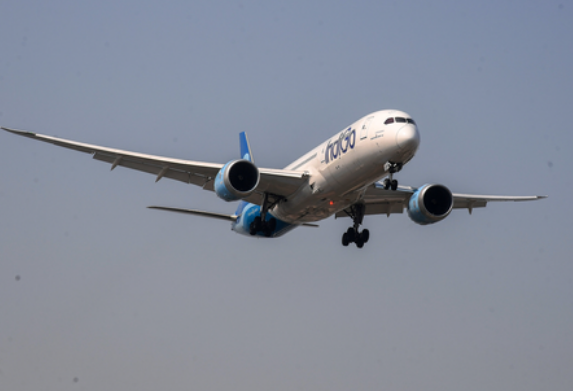
NEW DELHI–IndiGo Chief Executive Officer Willie Walsh expects strong passenger demand during the October-December quarter of fiscal 2027, even as India’s largest airline faces mounting fuel expenses and the possibility of further increases in ticket prices.
Walsh said advance bookings for the third quarter remain strong, suggesting that higher airfares have not significantly dampened demand for air travel.
“The picture for the third quarter remains positive,” Walsh told NDTV Profit, describing bookings for the period as “robust”.
His comments come after IndiGo reported a narrower quarterly loss despite a sharp increase in aviation fuel costs.
The airline recorded a consolidated net loss of Rs 1,879.1 crore for the September quarter, compared with a loss of Rs 2,582 crore in the corresponding period last year.
However, aircraft fuel expenses surged 67.2% to Rs 9,966.8 crore, placing considerable pressure on the company’s operating costs.
Walsh acknowledged that passengers would prefer more affordable tickets but said IndiGo must balance pricing decisions with its financial obligations.
“We understand that people would prefer to have lower prices. But obviously we have to have an eye on the financial stability of the company, and we’re trying to absorb as much as we possibly can.”
The airline has already indicated that additional fare increases may be necessary if fuel prices remain elevated.
“Given the very significant increase in our fuel bill, up 67 per cent in the quarter, and it will be much higher again in the third quarter, that’s clearly going to have an impact. But I don’t think it has a long-term impact,” Walsh said.
He noted that the September quarter is traditionally the weakest period for the airline industry and that executives at other carriers have reported similar seasonal trends.
According to Walsh, the increase in fuel expenses is affecting airlines worldwide, although the financial impact varies depending on how carriers manage fuel price risks.
“The pattern is global. European carriers are less affected because of pretty good hedging, but in the US, fuel costs are up over 60 per cent, similar to ours.”
He said U.S. airlines have managed to recover some of their additional fuel expenses through higher fares, although profitability has weakened across the industry.
“It’s going to be a short-term feature of the industry,” Walsh added.
Drawing on previous periods of volatility in global energy markets, Walsh pointed to major oil price increases in 2008 and 2022, including the disruption following Russia’s invasion of Ukraine.
“Not many of them are long-term; things tend to stabilise again,” he said.
Despite the immediate financial challenges, Walsh emphasized that IndiGo remains committed to its long-term expansion plans.
The airline continues to pursue its substantial aircraft order program, which is expected to support future capacity growth as additional planes enter service.
Walsh said the company sees no reason to alter its broader business plans because of the current increase in operating costs.
“No change in our long-term strategy,” he remarked.
The airline’s outlook reflects continued confidence in passenger demand, even as rising fuel prices create uncertainty over fares and profitability in the months ahead. (Source: IANS)