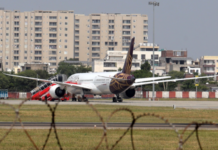

NEW DELHI— Air India announced on Tuesday that it has completed precautionary inspections of the fuel control switch (FCS) locking mechanisms on all Boeing 787 and Boeing 737 aircraft in its fleet, with no issues found.
The checks were conducted in accordance with a safety directive issued by the Directorate General of Civil Aviation (DGCA) earlier this month, following a fatal crash involving an Air India Boeing Dreamliner in Ahmedabad that claimed 260 lives.
“Air India has completed precautionary inspections on the locking mechanism of Fuel Control Switch (FCS) on all Boeing 787 and Boeing 737 aircraft in its fleet,” the airline said in a statement, confirming that the inspections found no faults.
The inspections were prompted by a preliminary report from the Air Accidents Investigation Bureau (AAIB), which revealed that both engines on the ill-fated aircraft shut down seconds after takeoff due to a fuel supply cutoff. Investigators found that the engine fuel cut-off switches had unexpectedly transitioned from ‘Run’ to ‘Cutoff,’ raising concerns over the reliability of the locking mechanism.
In response to the DGCA’s directive issued on July 14, both Air India and its budget subsidiary, Air India Express, launched immediate voluntary inspections. These began on July 12 and were completed within the regulator’s prescribed timeframe.
“The same has been communicated to the regulator,” the airline noted, adding that the Boeing 737 aircraft involved in the checks are part of the Air India Express fleet.
Air India emphasized its ongoing commitment to safety, stating, “Air India remains committed to the safety of passengers and crew members.”
In the wake of the Ahmedabad tragedy, several international carriers—including Emirates—have also begun similar inspections of their Boeing aircraft, even though the U.S. Federal Aviation Administration (FAA) has not issued a new airworthiness directive. The FAA has assured global aviation authorities that the current FCS design remains safe. (Source: IANS)