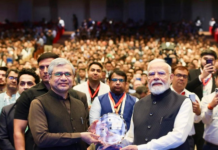


NEW DELHI— India’s rapidly expanding pool of semiconductor talent is drawing global chip design companies in large numbers, Union Minister for Railways, Information & Broadcasting, and Electronics & IT Ashwini Vaishnaw said on Tuesday.
Speaking at the inauguration of chip design giant ARM’s new office in Bengaluru, Vaishnaw emphasized that one of the core objectives of India’s Semiconductor Mission has been to build a strong and deep talent base — and that effort is now yielding results.
“Under the Semiconductor Mission, one of the major targets we have taken is to develop a very deep talent pipeline, and this is reflected in the way so many global design companies are coming to India because the talent is here,” Vaishnaw said.
The minister noted that the mission is supporting 278 universities and institutions across the country, giving students access to the latest electronic design automation (EDA) tools for chip design. So far, students have already designed 28 chips — a development he said reflects the growing confidence of global semiconductor companies in India.
Vaishnaw announced that ARM will develop advanced chips, including two-nanometer (2nm) designs, from its new Bengaluru facility. He congratulated the company for choosing India as a hub for such cutting-edge work.
The minister also pointed to broader growth in India’s semiconductor ecosystem, with suppliers of chemicals, gases, substrates, and manufacturing equipment establishing facilities in the country. At the same time, design capabilities are expanding, supported by design-linked incentive (DLI) programs and venture capital funding.
To boost innovation in next-generation technologies, Vaishnaw said the government has launched the India Deep Tech Fund, starting with $1 billion, to support artificial intelligence, semiconductors, biotech, and other advanced sectors.
Looking ahead, the minister said that Version 2.0 of the Semiconductor Mission will expand its focus to include developing equipment and materials required for chip manufacturing, alongside design and fabrication.
“We are working on the complete semiconductor stack — designing chips, manufacturing them, building the equipment and materials that go into making them, and developing the talent pipeline. The progress is very good, and this is just the beginning,” he said. (Source: IANS)