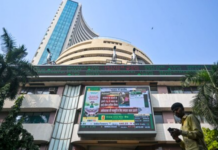

MUMBAI, India — Indian equity markets declined Thursday, ending a five-day winning streak as rising oil prices and uncertainty surrounding a potential U.S.-Iran ceasefire dampened investor sentiment.
The Nifty 50 fell 0.93 percent, or 222.25 points, to close at 23,775.10, while the Sensex dropped 1.20 percent, or 931.25 points, to settle at 76,631.65.
Analysts said intraday price action in the Nifty remained range-bound with a slight negative bias, marked by lower highs that signaled persistent selling pressure.
“A decisive and sustained move above 24,000 is required to improve sentiment and confirm strength, while failure to hold above 23,600 could expose the index to further downside pressure,” a market analyst said.
Selling was concentrated in key frontline stocks, with Jio Financial Services, InterGlobe Aviation, and Larsen & Toubro among the top losers in the Nifty index.
Despite weakness in benchmark indices, broader markets showed resilience. The Nifty MidCap and Nifty SmallCap indices ended higher, gaining 0.25 percent and 0.20 percent, respectively.
Sectorally, banking stocks weighed on the market, with the Nifty Private Bank and Nifty Bank indices underperforming. In contrast, metal stocks offered some support, with the Nifty Metal index emerging as the top gainer.
Investor sentiment remained cautious amid escalating geopolitical tensions. Iran’s Parliament Speaker Mohammad Bagher Ghalibaf expressed deep distrust toward the United States, citing repeated violations of agreements.
He pointed to Israel’s continued attacks on Lebanon and reported drone activity in Iranian airspace as factors contributing to heightened tensions, according to a statement shared on social media.
Market participants said renewed concerns over ceasefire stability and rising oil prices increased volatility, prompting profit-taking after the recent rally.
Meanwhile, the Indian rupee’s five-day rally ended, weakening alongside other Asian currencies.
“Spot USDINR is expected to trade within a range of 92.50 to 93.40, as traders balance global energy risks and domestic capital outflows,” a market expert said. (Source: IANS)