
NEW DELHI — India’s decision to join the United States and 24 other countries in shaping standards and security frameworks for next-generation 6G networks could give the country a significant role in setting the rules, spectrum policies and trust frameworks that will govern communications in the 2030s, according to a new report.
A report from India Narrative said India is shifting from being a major consumer of mobile technology to helping develop the rules, architectures and trust frameworks that will define the next decade.
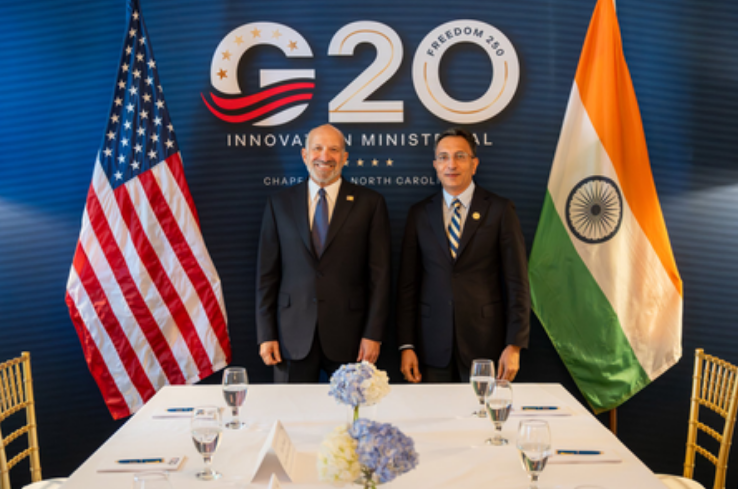
The decision was announced after Union Minister of State Jitin Prasada met U.S. Commerce Secretary Howard Lutnick on the sidelines of the G20 Innovation Ministerial.
India’s early involvement could allow its researchers, telecom operators, chip designers and startups to influence spectrum policy, security standards and interoperability requirements rather than adapting to standards developed elsewhere.
Countries that participate early in developing wireless standards often have greater opportunities to secure patents and gain a larger share of equipment markets, the report said.
India has joined the Call to Action for 6G Leadership and Security, a framework focused on network security, interoperability, resilience and trusted artificial intelligence.
The report described the language from Washington as “unusually clear,” noting its emphasis on ensuring that 6G reflects “shared security interests” while strengthening competitiveness and encouraging innovation.
The timing could also be significant as formal technical work on 6G is expected to accelerate beginning in 2027, while India’s Bharat 6G Alliance is targeting deployment by 2030.
Unlike earlier generations of wireless technology, 6G is expected to support far more than voice and video communications. It could become a foundation for industrial control systems, autonomous logistics, defense-related sensing and AI workloads running on Indian data centers.
“Aligning with partners who treat trusted vendors, supply-chain integrity and AI-in-the-loop as first-order design questions is a form of strategic hygiene,” the report said.
During his meeting with Lutnick, Prasada also pushed for greater U.S. participation in India Semiconductor Mission 2.0, stronger cooperation on AI technology and a practical mechanism for AI safeguards.
India’s digital public infrastructure, growing semiconductor fabrication and design ambitions, and software talent could allow the country to contribute technological capabilities to the partnership rather than serving solely as a large market for products, the report said. (Source: IANS)