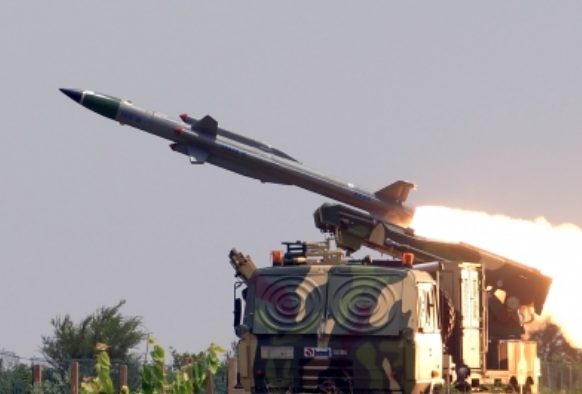
New Delhi — India has become the third-largest exporter of defense equipment to Europe, benefiting from increased military procurement under the European Union’s Rearm Europe initiative and the rapid expansion of its domestic defense manufacturing industry, Defense Secretary Rajesh Kumar Singh said Friday.
Singh said India’s defense exports have reached a record 38,424 crore rupees, equivalent to approximately 3.6 billion euros, with growing European demand for ammunition, artillery shells and other military supplies contributing to the increase.
“Our exports have reached an all-time high of Rs 38,424 crore, which is about 3.6 billion euros, and I was reading a Bloomberg report yesterday, which said that suddenly, over the last year, India became the third-largest exporter of arms to Europe, mainly because of the Rearm Europe initiative,” Singh told reporters.
He said European countries have significantly increased purchases of standard ammunition, artillery shells and both large- and small-caliber ammunition as they seek to strengthen their military capabilities.
According to Singh, India’s emergence as a major defense exporter reflects a decade of growth in the country’s domestic manufacturing sector.
India’s defense industrial base now includes 16 major public-sector companies, approximately 840 large and medium-sized private manufacturers and nearly 17,000 smaller enterprises, including startups.
“The result of this diversified industrial base is becoming visible in terms of the value of domestic sales, which are now almost 17 billion euros,” he said.
India currently exports defense products to more than 80 countries, supplying equipment ranging from artillery systems and ammunition to small arms, military helmets, bulletproof vests and other tactical gear.
Singh said the government is also working to strengthen domestic production by directing approximately 75% of its annual defense capital expenditure, estimated at $20 billion to $25 billion, toward purchases from Indian manufacturers.
The procurement policy prioritizes products that are indigenously designed, developed and manufactured, commonly referred to as IDDM, to reduce foreign dependence and strengthen technological sovereignty.
India is also pursuing additional defense export opportunities in Southeast Asia, where negotiations are underway for contracts involving military components, small arms and artillery systems.
Singh highlighted the changing structure of India’s international defense partnerships, noting that the country has gradually reduced its historical dependence on Russian military equipment.
“We still have a lot of our equipment that is of Russian origin, but over time that dependence has come down and we diversified; we already have fairly strong bilateral relations with some European countries, France in particular. But also with several other countries as well,” he said.
Russia remains a major source of military equipment for India, while France and Israel have emerged as significant suppliers. Singh estimated that France and Israel each account for approximately 15% of India’s defense imports.
He also pointed to growing strategic cooperation with Greece and Cyprus, describing the two Mediterranean countries as important partners in India’s expanding engagement with Europe.
Singh said India intends to deepen its participation in European defense procurement programs through joint ventures and manufacturing partnerships.
Under the proposed approach, Indian defense companies could establish joint ventures in Europe to access government procurement opportunities, while European manufacturers could expand their operations in India through similar arrangements.
“India intends to increasingly take part in Europe’s arms procurement program. Not directly, but by setting up joint ventures in Europe,” he said.
European companies would also be able to participate in India’s defense procurement programs, provided they comply with the government’s Make in India manufacturing requirements.
Singh emphasized that closer cooperation could help integrate Indian and European defense supply chains, allowing manufacturers to expand production and respond more effectively to rising international demand.
“I hope that this partnership agreement can lay the base for a situation where the supply chains between European and Indian defence manufacturers become increasingly integrated, and that is what we sort of intend to work on,” he said.
The expanding partnerships reflect India’s broader ambitions to become a major global defense manufacturing and export hub while reducing its reliance on imported military technology. (Source: IANS)