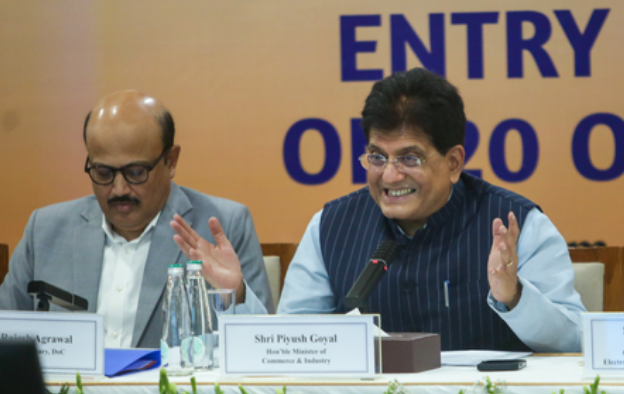
NEW DELHI–India’s ongoing trade negotiations with the United States will safeguard the interests of farmers and other sensitive sectors while strengthening the country’s competitive position in global markets, Commerce and Industry Minister Piyush Goyal said Thursday.
Goyal expressed confidence that once details of the proposed India-US trade agreement become public, Indians will recognize that the government has protected the interests of key stakeholders without compromising the country’s economic priorities.
Speaking at the Fourth National Conference on India’s Industrial Transformation, Goyal emphasized that international trade agreements should be evaluated based on comparative advantages and competitiveness rather than tariff reductions or trade volumes alone.
The conference was organized by the Institute for Studies in Industrial Development (ISID) and the Industrial Development Research Association (IDRA).
Goyal noted that several developed economies maintain high import duties on labor-intensive products, often using those tariffs as bargaining tools during trade negotiations.
He said India’s approach to international trade negotiations extends beyond lowering tariffs, establishing rules of origin and securing access to foreign markets.
According to an official statement, the government considers trade agreements comprehensive economic partnerships designed to expand export opportunities, protect vulnerable industries and improve access to advanced technologies.
These include graphics processing units (GPUs), memory technologies, medical equipment and other products considered important for India’s industrial and technological development.
Goyal said India’s trade negotiations also address services, foreign investment, education, workforce development, technology cooperation and climate-related commitments.
He emphasized that the government conducts extensive consultations with affected industries and stakeholders before concluding agreements to ensure that sensitive domestic interests receive adequate protection.
The minister said India’s trade agreements currently cover 38 developed and relatively prosperous countries, creating opportunities for mutually beneficial economic relationships.
Under this approach, India seeks to export products and services that trading partners require while importing technologies, equipment and other goods needed to support its own economic development.
Goyal highlighted the expansion of India’s international trade relationships in recent years.
He said nine free trade and bilateral trade agreements concluded by the government have opened preferential market access to economies representing a combined gross domestic product of approximately $60 trillion.
By comparison, trade agreements concluded before 2014 covered economies with an aggregate GDP of about $10 trillion, according to the minister.
Goyal argued that India’s earlier trade agreements were primarily with countries whose industries competed directly with Indian businesses.
The government’s current strategy, he said, places greater emphasis on partnerships with economies whose strengths complement India’s industrial and economic capabilities.
Beyond trade policy, Goyal called for a broader transformation of India’s manufacturing sector through improved product quality, larger production volumes and stronger integration with international markets.
He said achieving economies of scale and expanding global market access would be essential for making Indian manufacturers more competitive.
The minister also emphasized the importance of inclusive industrial growth and closer cooperation among government agencies, private businesses, universities and research institutions.
Such partnerships, he said, would help accelerate innovation, strengthen manufacturing capabilities and support the adoption of advanced technologies.
Goyal urged Indian industries to focus on becoming globally competitive while contributing to the government’s long-term economic development objectives.
He said coordinated efforts across government, industry and academia would be critical to establishing India as a leading global manufacturing economy.
The minister linked these priorities to India’s Viksit Bharat 2047 initiative, which aims to transform the country into a developed economy by the 100th anniversary of its independence.
His remarks come as India and the United States continue negotiations aimed at strengthening bilateral trade relations, with market access, tariff policies and protections for sensitive industries remaining central issues in the discussions. (Source: IANS)