
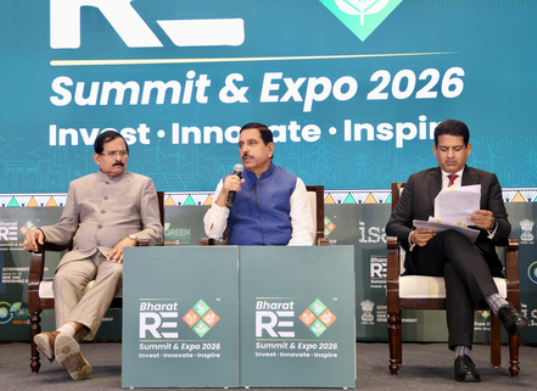
NEW DELHI–India is on track to surpass the $220 billion investment target needed to expand its non-fossil fuel power capacity to 500 gigawatts (GW) by 2030, Union Minister of New and Renewable Energy Pralhad Joshi said Thursday, citing strong investment flows and accelerating growth in the country’s clean energy sector.
Speaking at a press conference, Joshi said India had attracted approximately Rs 7 lakh crore in renewable energy investments over the past two years, including domestic capital and foreign direct investment.
The government estimates that an additional 190 GW of non-fossil fuel power capacity must be installed to reach its 2030 target. India currently has approximately 310 GW of installed non-fossil fuel power capacity.
Joshi said the rapid expansion of renewable energy infrastructure demonstrated the country’s growing ability to develop and deploy clean energy projects at scale.
“To achieve first 100 GW, it took seven decades, another 100 GW was achieved in seven years and the next 100 GW was added in two years,” he said.
The Minister expressed confidence that India would achieve its 500 GW target within the planned timeline.
He also said the government was developing strategies to add another 300 GW of power capacity following directions from Prime Minister Narendra Modi.
The expansion comes as India seeks to strengthen its energy security, reduce dependence on fossil fuels and attract additional investment into renewable energy infrastructure.
Joshi said the government had drawn lessons from previous global supply chain disruptions and was taking steps to strengthen preparedness against similar challenges in the future.
Meanwhile, the Ministry of New and Renewable Energy is working on new regulations governing the recycling of solar panels and wind turbine components as the country’s renewable energy infrastructure expands.
Speaking on the fourth day of the Bharat Renewable Energy Summit and Expo 2026, Ministry Secretary Santosh Kumar Sarangi said officials were preparing guidelines for recycling waste generated by solar modules.
“We are trying to formulate the guidelines as quickly as possible. This will also mandate manufacturers to produce modules which has higher degree of recyclability,” Sarangi said.
The proposed guidelines are expected to establish requirements encouraging manufacturers to produce solar panels that can be more easily recycled at the end of their operational lives.
Sarangi also addressed challenges associated with recycling wind turbine components, particularly blades made using epoxy-based composite materials.
Although most wind turbine components can be recycled, India currently lacks widely available technological solutions for processing certain blade materials and epoxy compounds.
He said wind energy company Suzlon and the Aditya Birla Group had signed a memorandum of understanding to develop fully recyclable epoxy materials for manufacturing wind turbine blades.
The initiative is intended to support the production of blades that can be completely recycled after their useful life.
Sarangi said the Ministry would need to establish standard operating procedures that could extend similar recycling requirements to other manufacturers.
Solar panel waste and discarded wind turbine components are currently regulated under India’s E-Waste (Management) Rules, 2022. However, officials said more detailed guidelines would be necessary to address the different materials and technologies used across the renewable energy industry.
“Under the e-waste rules, waste modules have to be preserved until 2035, by which time there is likely to be sufficient volume for recycling,” Joshi said.
The proposed recycling regulations would form part of India’s broader efforts to manage the environmental impact of its expanding renewable energy infrastructure while supporting long-term clean energy development. (Source: IANS)