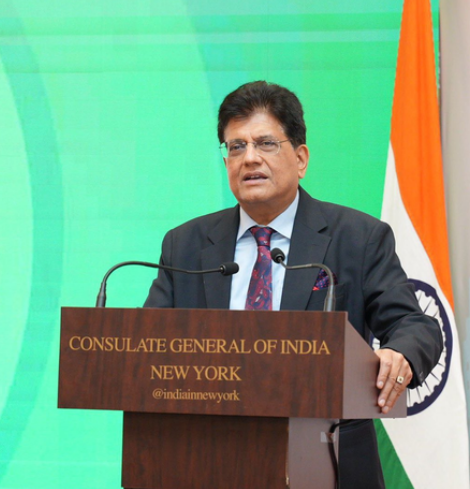
WASHINGTON– Indian Commerce and Industry Minister Piyush Goyal on Tuesday called for strengthening India–U.S. energy trade during a high-level session on energy security in New York.
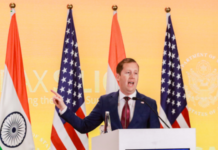
The event was co-hosted by the Consulate General of India in New York and also featured Member of Parliament Anurag Thakur. In remarks highlighted by the consulate, Goyal urged closer cooperation on nuclear power as an affordable clean energy option, alongside support for renewable energy start-ups.
He emphasized India’s “integrated national grid ensuring resilience and uninterrupted supply” and reaffirmed Prime Minister Narendra Modi’s vision of “One Sun, One World, One Grid.” Goyal also pointed to India’s achievements in solar energy, its role in the International Solar Alliance, and the country’s broader renewable energy push as evidence of its commitment to sustainable and inclusive growth.
The visit comes amid parallel trade negotiations between the two countries. On Monday, Goyal met U.S. Trade Representative Jamieson Greer in New York to continue discussions on an initial trade agreement. According to sources, both sides are working to resolve sticking points and hope to reach an interim understanding soon.
The talks follow earlier discussions in New Delhi between Brendan Lynch, U.S. Assistant Trade Representative for South and Central Asia, and India’s chief trade negotiator Rajesh Agrawal.
External Affairs Minister S. Jaishankar, also in New York for the UN General Assembly, met with U.S. Secretary of State Marco Rubio this week. Rubio described India as “critical” to Washington and welcomed progress in trade engagement. Jaishankar later wrote that their meeting covered a range of bilateral and global issues, underscoring the importance of sustained dialogue.
However, the broader trade atmosphere has been complicated by recent U.S. policy changes. President Donald Trump last week imposed a $100,000 fee on each new H-1B visa application. On Tuesday, the Department of Homeland Security followed up with a proposal to replace the existing H-1B lottery system with a weighted selection process that prioritizes higher-skilled applicants. (Source: IANS)