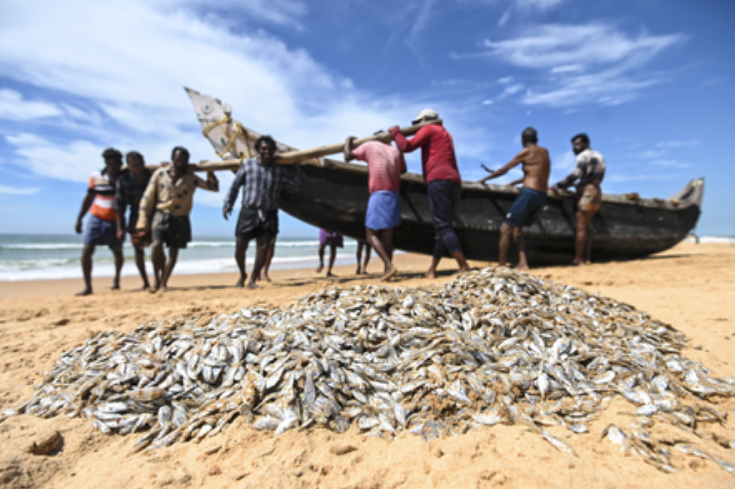
MUMBAI, India — India’s fish production has nearly doubled over the past 10 years, supported by expanded access to institutional credit and infrastructure financing, according to government data released on Monday.
About 4.76 lakh Kisan Credit Cards have been issued to the fisheries sector, with Rs 3,214.32 crore disbursed under fisheries lending schemes as of June 2025. In addition, loans worth more than Rs 13,000 crore have been approved for the sector under various central government schemes, an official statement said.
Under the Fisheries and Aquaculture Infrastructure Development Fund, 178 proposals involving loans of over Rs 6,369 crore had been approved as of July 2025. The fund, which has a corpus of Rs 7,522.48 crore and has been extended through March 2026, offers an interest subvention of 3 percent to encourage investment in fisheries infrastructure.
The Kisan Credit Card for Fisheries, introduced in 2018–19, continues to serve as the main short-term credit instrument for fishers and fish farmers. Loans under the scheme carry an interest rate of 7 percent, which is reduced to 4 percent for borrowers who repay on time.
To reduce lending risk for banks, the government has also set up a Rs 750 crore Credit Guarantee Fund, managed by NABSanrakshan, which provides coverage for collateral-free loans of up to Rs 12.5 crore, according to the Ministry of Fisheries, Animal Husbandry and Dairying.
The National Fisheries Digital Platform has onboarded 12 nationalised banks and enabled remote loan applications. More than 19,000 beneficiaries have applied through the platform, with around 350 approvals recorded so far. Loan disbursements under the system have ranged from Rs 15,000 to Rs 5 crore.
Fish production reached a record 197 lakh tonnes in FY 2024–25, nearly double the 95.79 lakh tonnes recorded in 2013–14. The government has set a target of 220 lakh tonnes by FY26.
The fisheries sector currently supports around three crore livelihoods and recorded exports worth Rs 62,408 crore in FY25. Frozen shrimp remains the leading export commodity, with the United States and China among the largest markets.
Officials said the sector contributes about 7.26 percent to India’s agricultural gross value added. Policy measures such as the reduction of GST on key fish products from 12 percent to 5 percent have helped boost domestic consumption and improve India’s competitiveness in global markets. (Source: IANS)