

NEW DELHI — Nvidia is aiming to generate up to $1 trillion in revenue from artificial intelligence chips by 2027, as the company positions itself at the center of a rapidly expanding AI ecosystem, CEO Jensen Huang said at the company’s annual GTC conference.
Speaking at the event in San Jose, California, Huang outlined Nvidia’s strategy to build an integrated platform spanning hardware, software, and infrastructure to support next-generation AI applications.
A key highlight of the keynote was Huang’s projection that cumulative demand for Nvidia’s upcoming AI platforms, including Blackwell and Vera Rubin systems, could translate into as much as $1 trillion in revenue over the next several years.
“I believe that computing demand has increased by 1 million times in the last two years,” Huang said, pointing to a surge in AI-driven workloads across industries.
Among the announcements, Nvidia introduced its Groq 3 Language Processing Unit, designed to accelerate AI inference tasks. The chip, expected to begin shipping in the third quarter, is built on the company’s GPU-based architecture with enhancements aimed at improving speed and efficiency.
The company also unveiled Vera Rubin Space One, a next-generation computing system being developed with partners for use in space-based data centers. A satellite launch associated with the project is expected later this year.
Huang emphasized what he described as the arrival of “physical AI,” predicting that industrial companies will increasingly adopt robotics powered by advanced AI systems.
“Physical AI has arrived — every industrial company will become a robotics company,” Huang said. “NVIDIA’s full-stack platform — spanning computing, open models and software frameworks — is the foundation for the robotics industry, uniting a worldwide ecosystem to build the intelligent machines that will power the next generation of factories, logistics, transportation and infrastructure.”
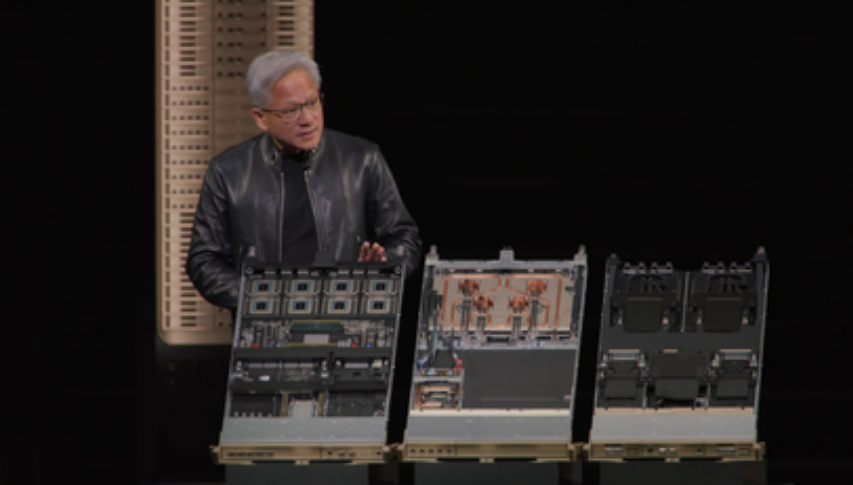
Nvidia also showcased a prototype of its next-generation rack-scale architecture, Kyber, which is expected to succeed the Rubin platform. The system is designed to integrate up to 144 GPUs in vertically stacked configurations to improve compute density and reduce latency, and is slated to be part of the Vera Rubin Ultra system targeted for release in 2027.
In the automotive sector, Huang said Uber plans to deploy a fleet powered by Nvidia’s Drive AV software across multiple global cities by 2028, with initial rollouts expected in Los Angeles and San Francisco as early as next year.
He added that automakers including Nissan, BYD, Geely, Isuzu, and Hyundai are developing Level 4 autonomous vehicles using Nvidia’s Drive Hyperion platform.
Nvidia has accelerated its innovation cycle in recent years, moving toward annual updates of its core product lineup while expanding into new AI-driven computing segments. (Source: IANS)