
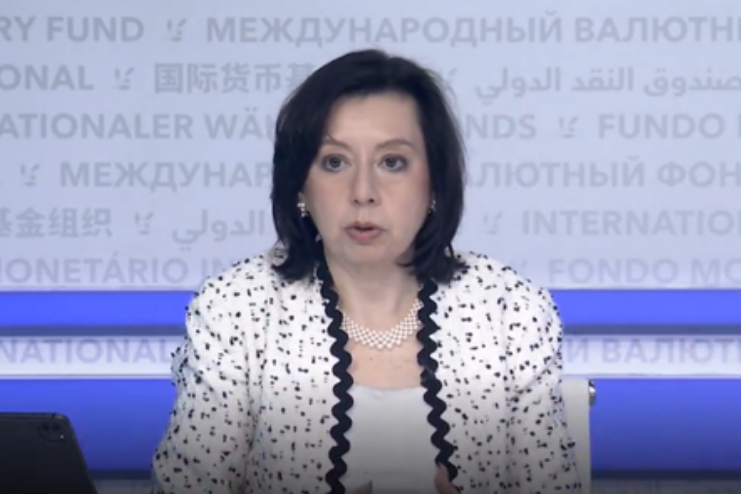

Washington — India remains a major engine of global economic growth despite the impact of the Iran conflict and higher energy prices, the International Monetary Fund said Thursday.
Julie Kozack, director of the IMF’s Communications Department, said India’s economy has remained resilient amid global economic pressures, supported by strong domestic demand.
“What I can say is that despite the impact of the war and global headwinds from the global economy, or externally, India’s economy has been growing robustly, and it has been supported, particularly by very strong domestic demand within India,” Kozack said during an IMF press briefing.
The IMF continues to forecast that India’s economy will grow 6.5 percent in fiscal year 2026-27, maintaining the upward revision it issued in April.
“We had projected growth at 6.5 per cent in fiscal year 26-27, and that was a slight upgrade compared to what we had had in January. So, 6.5 per cent is still quite strong growth,” Kozack said.
She said the outlook reflects strong momentum from last year and a reduction in U.S. tariffs, which helped offset some of the effects of the global energy shock.
“It also reflects the reduction in the US tariff rate, which had been set at 50 per cent and then was reduced to 10 per cent, and that reduction in tariffs also partly offset the impact of the global energy shock on India,” she said.
India’s economy grew 7.8 percent during the first quarter of the calendar year, exceeding the IMF’s earlier expectations.
“Right now, we see that there’s strong momentum that has continued in the first quarter of this calendar year. The economy in India had been growing in the first quarter at 7.8 per cent, and that was above what we had built into our projection for April for the first quarter,” Kozack said.
“So, there is quite strong momentum still in India. So, it does still remain a growth engine for the global economy, despite the shock.”
Kozack cautioned that India, a major energy importer, has not been insulated from supply disruptions and higher prices stemming from the Middle East conflict.
“I think it’s clear that the energy shock has had an impact globally and no country has really been untouched by the global shock,” she said.
“We did see that India did face supply disruptions with respect to energy. India was also affected by higher prices, like most countries in the world, because of the energy price shock, and of course, because India imports quite a lot of energy, we saw then, of course, the effect,” Kozack added.
The IMF views the recent Middle East ceasefire and progress toward reopening the Strait of Hormuz as positive developments for the global economy, Kozack said. Oil prices have fallen from their peak but remain about 10 percent above prewar levels, while prices for some other commodities have also begun to decline.
The IMF is scheduled to release updated global economic projections on July 8. (Source: IANS)