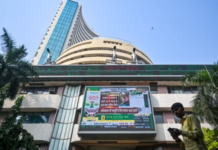

MUMBAI–Indian stock markets closed sharply lower Wednesday as investors booked profits following two consecutive sessions of gains, with selling pressure across consumer durables, metals, information technology and automobile stocks dragging down major benchmarks.
The BSE Sensex fell 500.38 points, or 0.61%, to close at 82,031.81, while the NSE Nifty 50 declined 159.45 points, or 0.63%, to settle at 25,227.95.
The losses reversed gains recorded during the previous two trading sessions, reflecting cautious investor sentiment and widespread selling across several major sectors.
Market analysts attributed the decline primarily to profit-taking, noting that the Nifty formed a bearish candlestick pattern during Wednesday’s session. However, buying interest at lower price levels helped limit additional losses.
“On the downside, 25,000 remains a crucial support, while 25,300 and 25,500 are immediate resistance levels. Overall, Nifty is expected to trade within the 25,000–25,500 range,” analysts stated.
Among individual stocks, Titan Company recorded the largest decline on the Nifty, followed by Hindalco Industries and HDFC Life Insurance Company.
Weakness in these major companies contributed to the overall decline in benchmark indices as investors reduced exposure to several large-cap stocks.
Broader market indices also struggled, with mid-cap and small-cap stocks generally underperforming their larger counterparts.
The Nifty MidCap 100 index dropped 1.22%, while the Nifty SmallCap 100 index declined 0.35%, highlighting continued selling pressure beyond the benchmark indices.
Consumer-focused companies experienced some of the steepest losses during the session. The Nifty Consumer Durables index led sectoral declines, followed by the Nifty Metal, Nifty IT and Nifty Auto indices.
Losses across these sectors outweighed gains in other areas of the market, contributing to the negative closing performance.
However, public sector banking stocks showed relative strength despite the broader market downturn. The Nifty PSU Bank index emerged as one of the strongest-performing sectoral benchmarks, while media stocks also finished the session in positive territory.
In the currency market, the Indian rupee strengthened approximately 0.08% to 93.44 against the U.S. dollar, supported by continued net buying from foreign institutional investors over recent weeks.
Market analysts said sustained foreign investment inflows and lower commodity prices could help support the rupee in the near term.
“Going ahead, continued foreign fund inflows and lower commodity prices could help maintain the rupee’s positive bias. The near-term trading range is seen between 93.00–93.75,” market experts noted.
Investors will continue monitoring foreign fund activity, commodity prices and broader market trends for indications of whether Indian equities can stabilize following Wednesday’s decline. (Source: IANS)