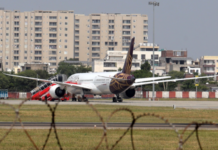

NEW DELHI— The Directorate General of Civil Aviation (DGCA) has directed all Indian airlines to inspect the locking mechanisms of fuel control switches on Boeing aircraft in their fleets, following revelations from the preliminary investigation into the deadly Air India Dreamliner crash in Ahmedabad last month.
The move comes after the Air Accidents Investigation Bureau (AAIB) reported that both engines of the ill-fated aircraft shut down just seconds after takeoff due to a fuel supply cutoff. The crash claimed 260 lives.
According to the AAIB’s preliminary findings, the aircraft’s engine fuel control switches abruptly moved from the ‘Run’ to ‘Cutoff’ position just three seconds after takeoff, raising serious concerns about a potential malfunction.
A chilling detail from the cockpit voice recorder captured one pilot asking the other, “Why did you cut off?”—to which the second pilot replied, “I didn’t.”
The AAIB also cited a 2018 bulletin from the U.S. Federal Aviation Administration (FAA), which had warned of a possible fault in the fuel control switches—manufactured by Honeywell and used in multiple Boeing aircraft models, including the 737 and the Dreamliner. The FAA had advised carriers to inspect the locking mechanism of the switches, though the recommendation was not mandatory.
Air India acknowledged that it did not carry out the recommended inspections, stating that the FAA’s guidance was classified as “advisory” rather than “mandatory.”
In the wake of the crash, several airlines—including Emirates—have begun conducting their own checks of the fuel switch locking mechanisms on Boeing aircraft as a precautionary safety measure.
Meanwhile, the FAA has reiterated that the current fuel control switch designs, including the locking features on Boeing aircraft like the Dreamliner, are considered safe. The agency has informed global civil aviation authorities that, at present, no airworthiness directive is necessary for Boeing operators.
Despite the FAA’s position, the DGCA’s directive signals a heightened focus on safety compliance and proactive risk mitigation across India’s aviation sector following the fatal crash. (Source: IANS)