
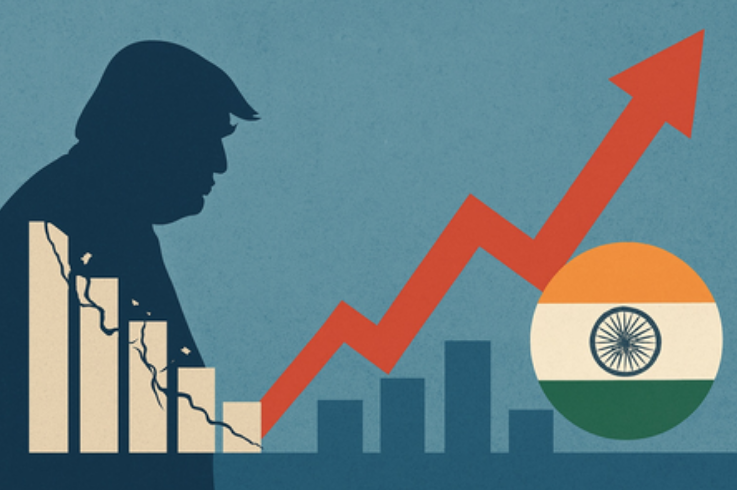
New Delhi– In a setback for U.S. President Donald Trump, who recently described India as a “dead economy,” the country’s growth surged to 7.8 percent in the April-June quarter, strengthening its position as the world’s fastest-growing major economy.
The robust performance follows 7.4 percent growth in the previous January-March quarter (Q4 FY25), underscoring the strength of India’s macroeconomic fundamentals. The economy is backed by strong foreign exchange reserves, sufficient to cover 11 months of imports, while inflation remains under control.
Union Commerce and Industry Minister Piyush Goyal said Friday that India’s exports this year will surpass last year’s levels, reflecting growing competitiveness and resilience. He emphasized that the government is working with partner countries worldwide to create new trade opportunities.
Goyal pointed to India’s expanding network of Free Trade Agreements (FTAs) with developed nations, including Australia, the UAE, Switzerland, Norway, Liechtenstein, Iceland, and the UK. Negotiations are also underway with the European Union and other countries. “These agreements will further open global opportunities for Indian industries such as construction, steel, and allied sectors,” he said.
He added that several developed countries are eager to deepen trade ties with India, noting that Qatar and the UAE have expressed strong interest in entering into FTAs.
The assurances came amid Washington’s decision to raise tariffs on Indian exports to 50 percent in retaliation for India’s purchases of Russian oil.
Economists said the macroeconomic impact of the tariff hike will likely be cushioned by the sheer size of India’s domestic market. A recent Morgan Stanley report described India as the “best placed country in Asia” amid global uncertainty triggered by Trump’s tariff threats, citing its relatively low ratio of goods exports to GDP.
“While India is exposed to direct tariff risks, we believe on balance India is less exposed to global goods trade slowdown, considering that it has the lowest goods exports to GDP ratio in the region,” the report stated.
A Fitch analysis added that the domestic market’s scale, which reduces reliance on external demand, is expected to insulate India from the U.S. tariff hikes, with GDP projected to expand by 6.5 percent in FY26. (Source: IANS)