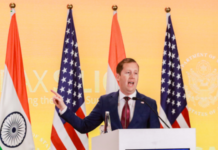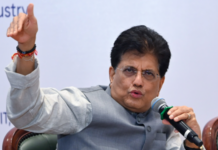
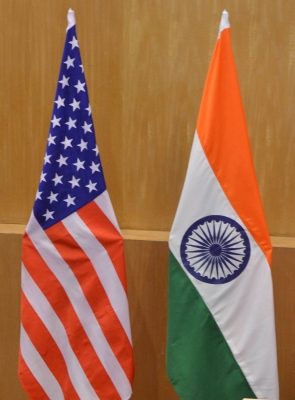
WASHINGTON — In a rare show of bipartisanship, Republican and Democratic lawmakers have come together to defend the United States’ relationship with India following a series of Trump administration policies that have strained bilateral ties.
Over the past 10 days, at least six bipartisan letters and resolutions have been introduced in Congress reaffirming support for the India–US partnership, defending the interests of the Indian American community, and demanding accountability for recent executive actions targeting New Delhi.
Last week, several House members raised concerns about an event at Rutgers University that they warned could “fuel further prejudice” against Hindus amid a surge in vandalism at Hindu temples. The letter was co-signed by Democrats Sanford Bishop of Georgia, Shri Thanedar of Illinois, and Suhas Subramanyam of Virginia, along with Republican Rich McCormick of Georgia.
Two days earlier, another bipartisan group of six House Representatives wrote to President Donald Trump and Commerce Secretary Howard Lutnick objecting to the administration’s new H-1B visa proclamation. “We are concerned that the recent proclamation related to H-1B visa petitions will create significant challenges for US employers and weaken our overall competitiveness,” the lawmakers wrote. The signatories included Democrat Suhas Subramanyam and Republican Representatives Jay Obernolte and Don Bacon, among others.
On October 17, four lawmakers urged President Trump to attend the Quad Leaders’ Summit in India and other upcoming regional meetings, while the same day, a bipartisan resolution introduced in the House recognized the contributions of the Indian American diaspora and condemned recent acts of racism against Indian Americans. The resolution described the India–US partnership as “one of the most important democratic relationships in the world.”
This growing bipartisan defense of India contrasts with a letter earlier in the month signed by 19 Democrats urging the administration to “reset and repair” relations with New Delhi—an effort that lacked Republican support.
Lawmakers from both parties have been criticized for staying largely silent while senior Trump administration officials, including Trade Advisor Peter Navarro and Commerce Secretary Howard Lutnick, repeatedly faulted India for importing Russian oil and maintaining a trade imbalance. In August, the administration imposed 50 percent tariffs on Indian imports, including a 25 percent levy on Russian crude. A month later, President Trump introduced a $100,000 H-1B visa application fee, a move that hit Indian workers hardest, as they accounted for more than 70 percent of approved petitions in 2024.
Democratic Representative Ami Bera, a leading voice in support of India–US ties, acknowledged earlier this month that many Republican lawmakers had been hesitant to confront the administration. “I think they’re certainly afraid to take on President Trump directly,” Bera told IANS.
Recent developments, however, suggest signs of stabilization. Trade talks have resumed, and last week President Trump hosted a Diwali celebration at the White House, calling Prime Minister Narendra Modi “a great person” and expressing admiration for “the people of India.”
Bera emphasized that the relationship should transcend partisan lines. “Instead of making this about President Trump, let’s make it about the US–India relationship,” he said. “I don’t want the India–US relationship to be a Democratic thing or a Republican thing. It should be an American thing.” (Source: IANS)