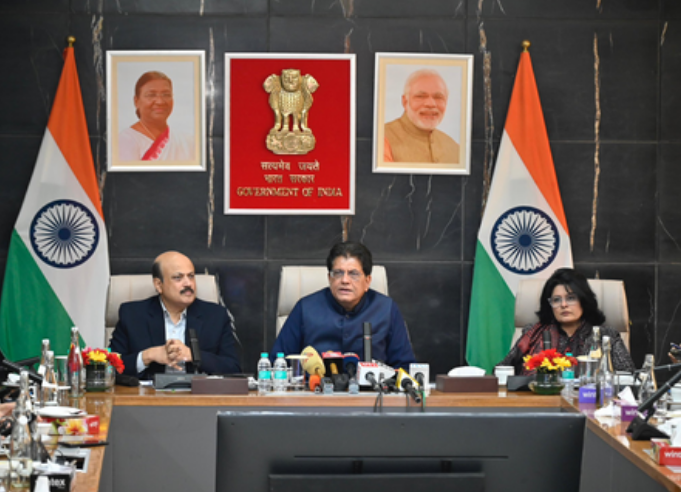

NEW DELHI– India and the United States are in the advanced stages of negotiating a bilateral trade agreement, Commerce and Industry Minister Piyush Goyal said on Monday, signaling progress toward easing trade barriers between the two countries.
Speaking to reporters, Goyal said India has already concluded free trade agreements with three members of the Five Eyes intelligence alliance — Australia, the United Kingdom and New Zealand — while the United States and Canada remain outside those deals.
He added that India is preparing to re-engage Canada on a bilateral trade pact. “We are soon going to launch discussions for the terms of reference with Canada also,” Goyal said, noting that the move reflects India’s growing strategic importance in global geopolitics.
Goyal’s comments come after talks earlier this month between Indian officials and a U.S. delegation led by Deputy Trade Representative Rick Switzer in New Delhi.
Commerce Secretary Rajesh Agrawal had earlier said India is “very close” to finalising an initial framework agreement with the U.S. aimed at lowering reciprocal tariffs. Speaking at a December 15 press conference, Agrawal said the two sides have completed six rounds of negotiations covering both a proposed Bilateral Trade Agreement and an interim arrangement to reduce tariffs.
“We are very close to closing the initial framework deal, but I don’t want to put a timeline to it,” Agrawal said, adding that there is a reasonable expectation of reaching an interim agreement to ease high tariffs on most Indian exports.
Goyal said trade discussions with the U.S. are progressing well but ruled out setting any deadline for signing a deal. Referring to Switzer’s two-day visit to Delhi, he said substantive discussions were held but stressed that agreements must benefit both sides.
“A deal is only done when both sides stand to benefit. We should never negotiate with deadlines because you tend to make mistakes then,” Goyal said.
Agrawal also said the two countries exchanged views on a wide range of issues related to bilateral trade and economic ties, including negotiations for a mutually beneficial trade agreement.
U.S. President Donald Trump recently told reporters at the White House that his talks with Prime Minister Narendra Modi were “going great” and indicated that a visit to India could take place next year. Trump said he plans to lower tariffs on India “at some point,” raising expectations of a possible breakthrough in negotiations.
India, however, has made it clear that it will not compromise on the interests of farmers, the dairy sector or workers in any trade agreement.
India has also begun increasing its purchases of oil and gas from the U.S. as part of efforts to reduce its trade surplus. In this context, Petroleum and Natural Gas Minister Hardeep Singh Puri recently announced that India’s public sector oil companies have concluded a one-year structured contract to import about 2.2 million tonnes per annum of LPG from the U.S. Gulf Coast in 2026.
The imports will account for nearly 10 percent of India’s annual LPG requirements and mark the first such structured LPG contract between India and the U.S. for the Indian market. Puri described the agreement as a historic development, saying it opens one of the world’s largest and fastest-growing LPG markets to the United States. (Source: IANS)