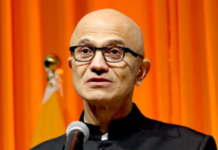


Washington — Microsoft CEO Satya Nadella has warned that control over artificial intelligence should not become concentrated among a handful of companies as the technology transforms economies, workplaces and society.
In an interview with The Wall Street Journal, Nadella outlined a vision for the next stage of AI development that emphasizes lower-cost models, greater user control and wider access to the technology.
“You can’t say, hey, all white-collar jobs are gone and this could even be a weapon and we will use all the power to build data centres,” Nadella said.
He argued that the public would be unlikely to accept a future in which only a small group of companies controlled how AI is developed, deployed and monetized. The industry, he said, must earn public trust and secure what he called “social permission” to continue expanding.
Nadella’s comments add to a growing debate over whether the benefits of AI will be broadly distributed or largely captured by a small number of powerful technology companies.
Although he did not identify any competitors by name, Nadella criticized an approach in which a few companies retain most of AI’s economic value while warning about safety risks, job losses and the enormous resources needed to build increasingly advanced systems.
Microsoft is also weighing whether to host models developed by DeepSeek, a Chinese AI company that has drawn international attention for producing lower-cost systems. Hosting DeepSeek could broaden the company’s global reach while increasing competitive pressure on leading AI developers.
Nadella said AI’s future should be more open and less dependent on a small group of developers producing the most advanced models. He also argued that companies should use the technology to restructure work rather than simply eliminate jobs.
“No, how about we think about reorganizing the jobs?” he said.
Nadella acknowledged that widespread adoption of AI would cause disruption but said businesses must create realistic ways for employees to adjust.
“Yes, it’s a lot of change management, it’s a lot of displacement, but there is a path,” he said.
He described AI as a knowledge engine that could help organizations make more effective use of employees, information and technology. In his view, companies should be able to choose among multiple AI models offering different capabilities and prices instead of depending on a single provider.
Nadella said restoring confidence in the technology industry would require companies to demonstrate responsible conduct rather than rely solely on public assurances.
“No amount of just narrative is going to do it because where we are now, we have to sort of walk the walk,” he said. “We now have to do the hard work in earning the social permission.”
The comments come as governments, businesses and workers confront growing concerns over AI’s effects on employment, economic power and global competition. Major technology companies are investing heavily in data centers, computing infrastructure and other resources needed to develop and operate AI systems.
Microsoft remains one of the industry’s most influential companies through its investments, cloud infrastructure and partnerships with leading AI developers. (Source: IANS)