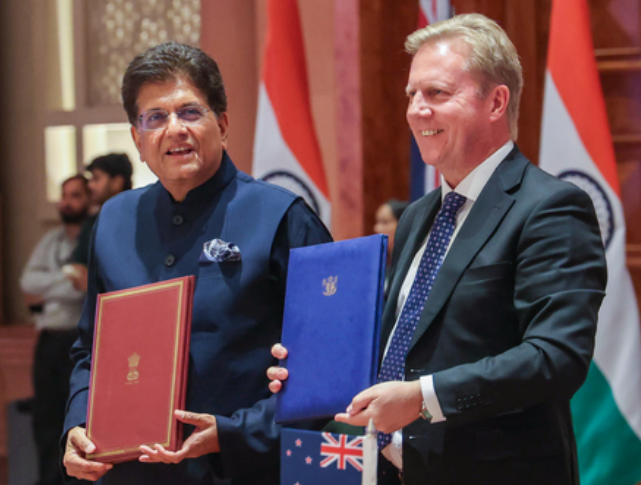
NEW DELHI — India’s free trade agreement with New Zealand is the country’s first women-led pact and a milestone in bilateral economic ties, Commerce and Industry Minister Piyush Goyal said Monday.
Goyal said a majority of the negotiating team consisted of women, including the chief negotiator, deputy negotiator and several sectoral leads, calling it a significant step for gender inclusivity in trade negotiations.
The agreement, backed by Prime Minister Narendra Modi and New Zealand Prime Minister Chris Luxon, was concluded in a record nine months with the efforts of New Zealand Trade Minister Todd McClay and both negotiating teams.
Goyal said the pact reflects “deep mutual trust, shared ambition, and a common commitment to prosperity.”
The deal grants 100 percent duty-free access for Indian exports to New Zealand, opening opportunities for MSMEs, farmers, women, youth, professionals and job-creating sectors, while protecting sensitive domestic industries through a balanced framework.
He said the agreement is expected to facilitate $20 billion in investment into India, strengthening cooperation in trade, services, investment, innovation, agriculture productivity and education, while creating pathways for skilled workers and students.
The FTA also includes provisions on mobility for professionals and students. New Zealand has signed an annex on student mobility and post-study work visas for the first time with any country, allowing Indian students to work up to 20 hours per week while studying, along with extended post-study work visas.
The agreement provides a quota of 5,000 visas for skilled Indian workers for stays of up to three years in sectors including AYUSH, yoga instruction, hospitality and music, as well as IT, engineering, healthcare, education and construction.
Under a working holiday visa program, 1,000 young Indians annually will be allowed multiple entries into New Zealand for a period of 12 months.
India has excluded several items from the agreement, including dairy products such as milk, cream, whey, yogurt and cheese, along with certain agricultural products including onions. (Source: IANS)