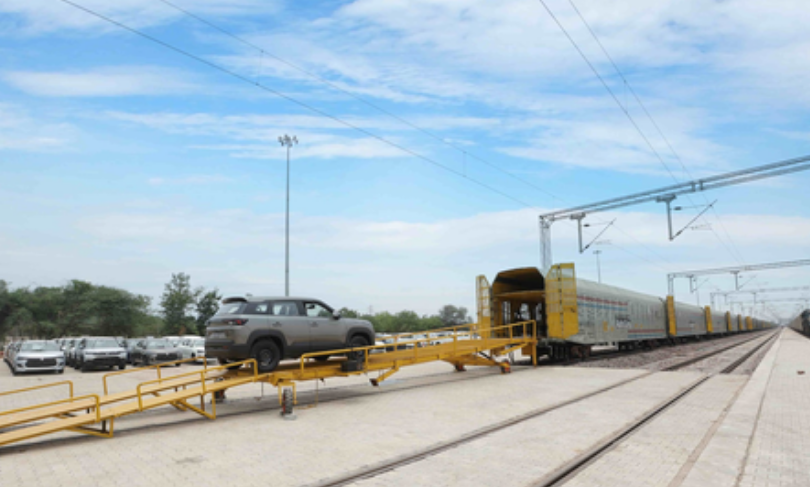
NEW DELHI — Maruti Suzuki India said Wednesday it has crossed 3 million cumulative vehicle dispatches through the Indian Railways network, marking a milestone in the automaker’s effort to expand greener logistics operations.
The company, India’s largest passenger vehicle maker, said it has steadily increased the use of rail transport in its outbound logistics over the past decade. Rail accounted for 5% of the company’s total vehicle dispatches in fiscal 2015, compared with 26.5% in fiscal 2026.
Maruti Suzuki said it moved from 2 million to 3 million cumulative rail dispatches in just 21 months, making it the fastest addition of 1 million vehicles transported by rail in the company’s history.
Hisashi Takeuchi said the milestone represents an important step in Maruti Suzuki’s green logistics strategy. He said rail dispatches have increased nearly ninefold since 2014 and now account for more than a quarter of the company’s total vehicle movement.
“Maruti Suzuki has committed over Rs 13,720 million towards dedicated green logistics infrastructure,” he said.
Takeuchi also credited the government’s PM GatiShakti National Master Plan with helping create a framework for integrated and multimodal logistics, supporting a broader industry shift toward rail-based freight transportation.
Maruti Suzuki aims to increase the share of rail-based vehicle dispatches to 35% by fiscal 2031. The company also plans to build an in-plant railway siding at its upcoming Kharkhoda facility, which it said would help reduce carbon emissions, lower fuel consumption and ease road congestion.
The automaker said it is currently the first and only passenger vehicle manufacturer in India to operate railway sidings inside two manufacturing facilities, at Hansalpur in Gujarat and Manesar in Haryana.
Both facilities were developed under the PM GatiShakti National Master Plan. Together, the two in-plant railway sidings have an annual dispatch capacity of 750,000 vehicles.
Maruti Suzuki said its rail logistics network serves more than 600 cities through 22 hubs using a hub-and-spoke model. (Source: IANS)